

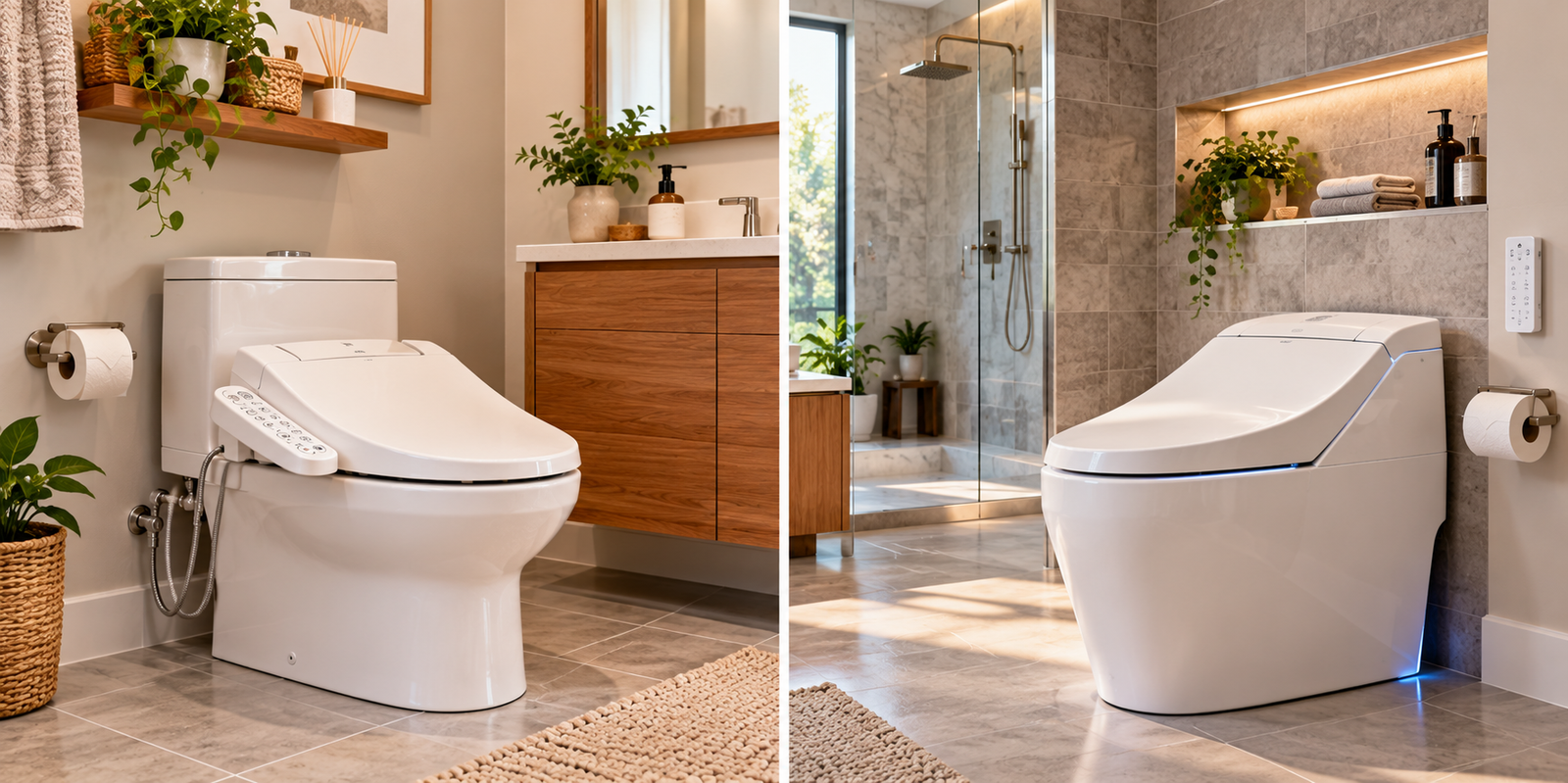
A bathroom upgrade does not always require new tile or a complete remodel. Sometimes the most noticeable improvement is a toilet seat with water cleansing, adjustable settings and greater everyday comfort. At the other end of the market, integrated smart toilets build similar functions into an entirely new fixture.
Interest is growing. The 2026 U.S. Houzz Bathroom Trends Study, released September 30, surveyed 1,619 U.S. homeowners involved in bathroom renovations. Among those installing new or upgraded toilets, 47% included specialty features, up nine percentage points year over year. Bidet toilet seats were the most common specialty feature at 31%, followed by adjustable water pressure at 30%, air dryers at 28% and heated seats at 27%. These percentages describe surveyed renovators, not all American households.
Should you install a bidet seat on your existing toilet or replace the entire fixture with a smart toilet? The answer depends on compatibility, plumbing, electricity, maintenance and budget.
What Is the Difference?
A bidet toilet seat replaces the seat on a compatible toilet. It connects to the water supply and provides a cleansing spray. Non-electric versions typically use manual controls and cold water. Electric versions may add warm water, heated seating, adjustable pressure, nozzle positioning, drying and remote operation.
An integrated smart toilet combines a toilet bowl and electronic features into one fixture. Depending on the model, it may offer water cleansing, hands-free flushing, automatic lid operation, deodorizing or night lighting.
Both can deliver similar daily functions. The essential distinction is whether you keep a working toilet or replace the complete fixture.
Bidet Seat vs. Smart Toilet: Quick Comparison
| Factor | Bidet seat | Integrated smart toilet |
| Existing toilet | Retained | Replaced |
| Plumbing | Seat water connection | New fixture installation |
| Power | None for some mechanical seats | Usually required |
| Appearance | Separate seat | Integrated |
| Features | Basic to advanced | Often advanced |
| Compatibility | Bowl shape and mounting | Rough-in and footprint |
| Repairs | Seat can often be replaced | May involve proprietary parts |
| Project cost | Often lower | Usually higher |
Actual features and installation requirements vary by product.
Why Bidet Features Matter in 2026
Houzz’s latest study shows increasing interest in adjustable spray pressure, warm-air dryers and heated seats. Separately, the National Kitchen & Bath Association’s 2026 Bath Trends Report found that 51% of surveyed industry professionals expected smart toilets to gain popularity over the following three years.
The NKBA result is a forecast from professionals, not a measure of sales. Together, the reports suggest that toilet comfort and convenience deserve more attention during bathroom planning.
Three Upgrade Options
Non-Electric Bidet Seat
A mechanical model is an entry-level option when cleansing is the main goal and no power outlet is available. It typically connects to the cold-water supply. Heating and powered drying are generally absent.
Electric Bidet Seat
An electric seat offers more comfort features without requiring a new bowl. It can be a practical choice when the existing toilet is reliable, properly sized and compatible with the seat.
Integrated Smart Toilet
A complete smart toilet is worth considering when the old toilet needs replacement or when an integrated design and particular advanced functions are important. It requires careful planning for plumbing, electrical service and future maintenance.
Will a Bidet Seat Fit Your Toilet?
Not every seat fits every toilet. First identify whether the bowl is round-front or elongated. Measure its length, mounting-hole spacing and clearance between the holes and tank.
Some one-piece toilets have curved rear surfaces or unusual mounting systems that complicate compatibility. Check the manufacturer’s fit guide for the exact model before ordering.
Also consider side clearance. A control panel can be difficult to reach beside a wall or vanity. A remote-controlled seat may be more convenient in a narrow bathroom.
Electrical Requirements
Electric bidet seats and most smart toilets need a suitable power connection near the fixture. Bathrooms require particular electrical protection because water and electricity may be close together.
The Electrical Safety Foundation International identifies GFCI protection as an important requirement for bathroom receptacles under applicable electrical rules. A GFCI disconnects power when it detects a ground fault.
Before remodeling, check the selected product’s voltage, power rating, cord length, outlet position and any requirement for a dedicated circuit. Have a qualified electrician confirm the locally adopted code and available circuit capacity.
Do not rely on a permanent extension cord. If a suitable outlet is missing, plan the work before new wall finishes are installed.
Plumbing and Backflow Protection
A retrofit seat commonly connects through a tee fitting at the existing toilet water supply. The hose, valve and mounting hardware must be compatible and installed without leaks.
Backflow protection is equally important. Water from a cleansing device must not contaminate the drinking-water supply. The 2024 International Plumbing Code contains provisions addressing backflow protection for bidets; other locally adopted requirements and product standards may apply to bidet seats.
Ask a qualified installer to verify product approval and the required backflow arrangement. A hose that fits a supply valve does not establish code compliance.
For a complete toilet replacement, confirm the rough-in dimension, flange location, supply position, required water pressure and fixture clearances.
What Does the Upgrade Cost?
A basic mechanical attachment generally has the lowest purchase price. Electric seats cost more, while integrated smart toilets typically have the highest total project cost.
Compare the complete installed price rather than the sticker price alone. Include plumbing labor, electrical work, old-fixture removal, accessories, wall or floor repairs, warranty coverage and future service.
For example, an integrated toilet with a different footprint may expose unfinished flooring. A seat retrofit may require an electrician even when the plumbing connection is straightforward.
Request itemized quotes using specific models. There is no dependable universal installation price for every bathroom.
Which Features Are Worth Paying For?
- Adjustable pressure and nozzle position: Useful for households with different comfort preferences. Easy controls matter more than numerous presets.
- Warm water and heated seating: Can improve comfort in colder climates. Compare heating methods, startup time and energy-saving settings.
- Warm-air drying: May reduce toilet-paper use, though performance and user preferences vary.
- Remote control: Can be easier to operate than a side panel, especially in a narrow room.
- Night light: Adds convenience but does not replace proper bathroom lighting.
- Automatic lid and flush: Convenient for some households, but they add mechanical complexity. Ask what happens during a power outage.
Do Bidets Save Water?
A bidet may reduce toilet-paper consumption, but it uses water for cleansing, and electric versions use energy. Its overall environmental impact depends on the device and user behavior. Avoid assuming every bidet saves a fixed amount of water.
Flush efficiency is a separate issue. The U.S. Environmental Protection Agency states that WaterSense-labeled tank-type toilets use 1.28 gallons per flush or less and meet independently certified performance requirements.
Adding a bidet seat does not change the existing toilet’s flush volume. If conservation is important, verify the toilet’s actual WaterSense certification.
Cleaning and Long-Term Maintenance
Self-cleaning nozzle functions do not eliminate regular bathroom cleaning. The bowl, seat hinges, nozzle housing and surrounding surfaces still require attention.
Use only manufacturer-approved cleaners. Abrasive tools and harsh chemicals can damage plastic components, seals, finishes and sensors.
Before purchasing, check how the seat detaches for cleaning, whether nozzles are accessible, how filters are maintained and whether replacement parts are available.
An integrated fixture may use proprietary electronics and plumbing components. Ask about local service and the cost of future repairs.
Accessibility and Aging in Place
Water cleansing and easy-to-reach controls may help some people who have difficulty with conventional wiping. However, a bidet does not automatically make a bathroom accessible.
Evaluate seat height, transfer space, grab-bar placement, approach clearance and the user’s ability to operate the controls. A remote may suit some users better than a side panel.
For regulated projects, the complete installation must meet applicable accessibility standards. Canadian projects should follow the relevant provincial and local requirements.
Seven Questions to Ask Before Buying
- Does this exact seat fit the existing toilet?
- Is a suitable GFCI-protected outlet within permitted cord reach?
- Does the plumbing connection include the required backflow protection?
- Which functions remain available during a power outage?
- Can the seat and nozzle be cleaned easily?
- Are replacement parts and qualified service available locally?
- What is the total installed cost, including electrical and plumbing work?
Frequently Asked Questions
Can You Add a Bidet Seat to Any Toilet?
No. Compatibility depends on bowl shape, mounting dimensions and clearance behind the seat. Use the manufacturer’s fit guide.
Do Bidet Seats Need Electricity?
Mechanical versions generally do not. Electric versions require suitable power for heating, drying and other powered features.
Is a Smart Toilet Better Than a Bidet Seat?
Not necessarily. An integrated toilet offers a cohesive appearance, while a compatible electric seat may provide similar daily comfort without replacing a functioning fixture.
Do Bidets Eliminate Toilet Paper?
Some people use less, particularly with a dryer, but many still use a small amount.
Can a Bidet Seat Save Water?
It adds cleansing water and does not alter the toilet’s flush volume. Any broader resource savings depend on use.
Can I Install a Bidet Seat Myself?
Some models are designed for straightforward retrofits, but plumbing compatibility and backflow requirements must be checked. New electrical work should be performed by a qualified professional.
Final Verdict
If the existing toilet is comfortable, reliable and compatible, an electric bidet seat is often the most practical way to add cleansing and comfort features. A non-electric seat offers a simpler entry point when power is unavailable.
A complete smart toilet becomes more compelling when the fixture already needs replacing or an integrated appearance and specific advanced functions are priorities.
The 2026 trend data confirms growing interest in these features. The right purchase is not necessarily the most elaborate one. It is the product that fits the bathroom, meets safety requirements, is serviceable and makes everyday routines easier.