
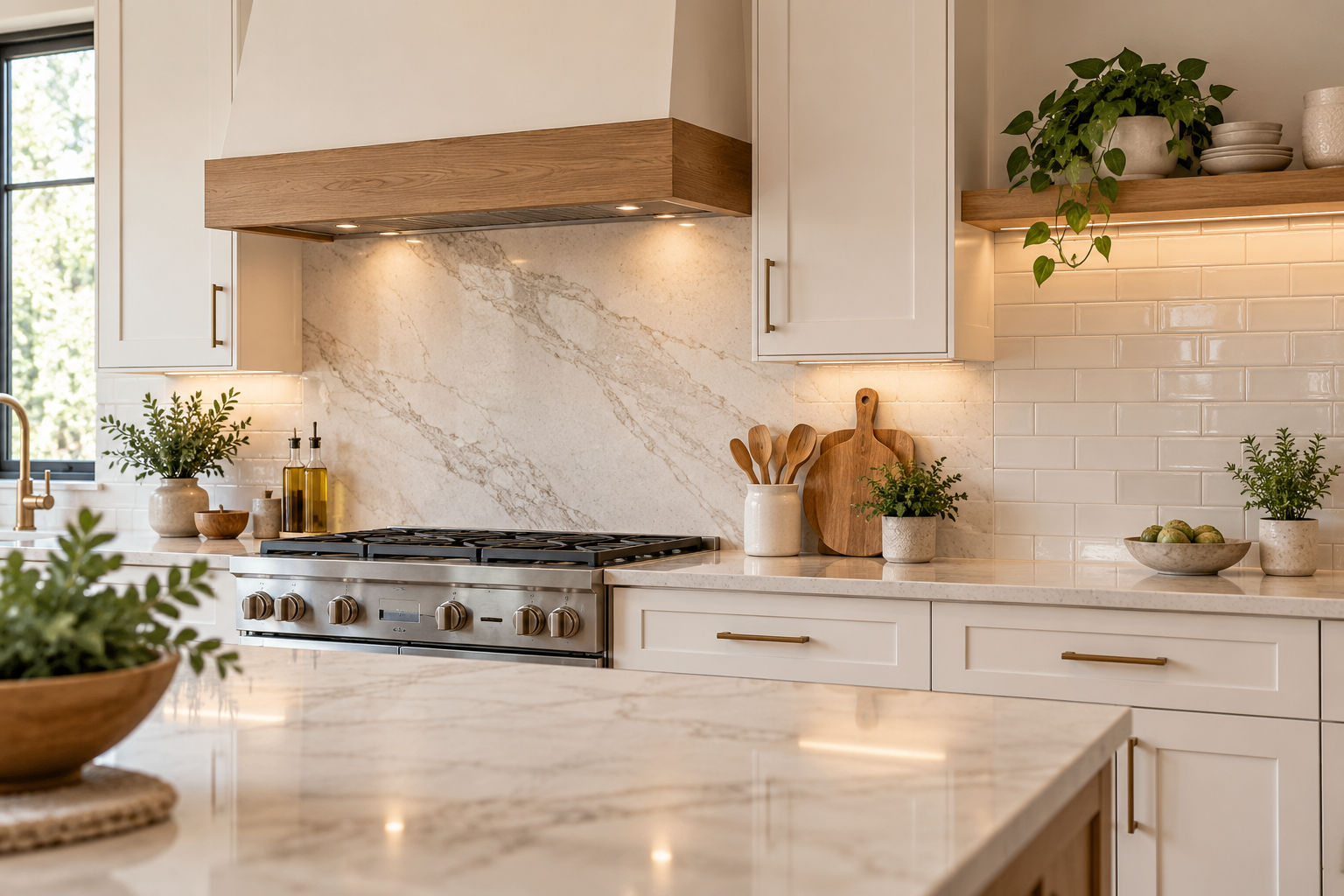
A kitchen backsplash used to be one of the last decisions in a renovation. Choose a tile, pick a grout color, and fill the wall between the countertop and upper cabinets. Today, that narrow strip can become one of the kitchen’s defining design features.
Large stone-look panels, countertop-to-ceiling surfaces, handmade-look ceramic tile and carefully mixed materials are giving homeowners more options. But the most important decision is often simpler: Should you use a continuous slab or individual tiles?
The 2026 U.S. Houzz Kitchen Trends Study gives this comparison a timely context. Among surveyed homeowners adding or upgrading a backsplash, 72% chose tile and 28% chose a slab-style backsplash. Slab’s share increased from 24% in the previous year’s study.
In the National Kitchen & Bath Association’s 2026 Kitchen Trends Report, 75% of surveyed industry professionals identified slab or solid-surface backsplashes as gaining popularity.
Those findings do not mean tile is disappearing. They show two different preferences coexisting: the seamless appearance of slabs and the flexibility of tile.
Here is how to choose based on everyday use, materials, installation and the kitchen you actually have.
What Is a Slab Backsplash?
A slab backsplash uses one or more large-format panels instead of many small tiles. The panel may be natural stone, engineered quartz, porcelain, sintered stone or another surface approved for vertical installation.
A full-height slab often extends from the countertop to the underside of upper cabinets, a range hood or even the ceiling. Some kitchens continue the same countertop material up the wall, creating a visually continuous surface.
A slab is not always literally one piece. Long walls, corners, large windows, outlets and fabrication limits may require seams or multiple panels.
The goal is fewer visible joints, not necessarily a joint-free installation.
What Is a Tile Backsplash?
A tile backsplash is assembled from individual pieces, commonly ceramic, porcelain, glass or natural stone.
Tile can be rectangular, square, hexagonal or another shape, and it can be arranged in a wide range of patterns.
Tile joints are filled with an appropriate grout, while changes of plane and other designated movement locations require compatible flexible sealant or other movement-joint treatment.
Tile remains the majority choice in Houzz’s 2026 study. Among homeowners selecting backsplash tile, ceramic led at 49%, followed by porcelain at 23%. Rectangular shapes and horizontal brick layouts also remained common.
Tile’s advantage is versatility. Homeowners can create a quiet background, a handcrafted look or a strong pattern without requiring a single oversized panel.
Slab vs. Tile Backsplash: Quick Comparison
| Factor | Slab Backsplash | Tile Backsplash |
| Visual appearance | Broad, continuous surface | Patterns, texture and visible joints |
| Cleaning | Fewer joints to clean | Grout lines require attention |
| Material cost | Often higher for premium stone | Wide range of affordable and premium options |
| Installation | Specialized templating and fabrication | Labor depends on tile size and pattern |
| Repairs | Large panels can be difficult to replace | Individual tiles may be replaceable |
| Customization | Large-scale veining and color continuity | More shapes, patterns and accent options |
| Heat near range | Material and appliance compatibility required | Material and appliance compatibility required |
| Maintenance | Depends on the surface | Depends on tile and grout |
| Best application | Seamless, contemporary kitchens | Traditional, transitional and customized kitchens |
Neither category is universally better.
Product selection and installation quality matter as much as format.
What the 2026 Kitchen Trends Actually Show
Houzz’s 2026 report found engineered quartz was the leading material among slab backsplash selections, at 39%, followed by quartzite at 33%.
Granite, marble and porcelain accounted for smaller shares of slab selections.
The same study reported that 67% of upgraded backsplashes extended to the cabinets or range hood, while 10% reached the ceiling.
NKBA’s 2026 report offers a complementary professional perspective.
Slab and solid-surface backsplashes were widely identified as a growing design direction, while backsplashes were also named as a place to introduce statement color.
The two findings are not contradictory.
One describes homeowner choices in a particular renovation survey. The other describes what industry professionals expect to gain popularity.
Neither provides a guarantee that one material will dominate future kitchens.
Which Is Easier to Clean?
For a household that cooks frequently, cleaning is a major consideration.
A smooth slab can be convenient because a cloth moves across a broad surface without encountering dozens of grout lines.
This can be especially helpful behind a sink or food-preparation counter.
However, the material itself still matters.
A polished marble slab can be more sensitive to acidic substances than a glazed ceramic tile.
Natural stone may require a suitable sealer depending on its porosity and the supplier’s instructions.
Some textured porcelain slabs can also hold grease in surface details.
Tile adds grout joints, which can collect residue if cleaning is neglected.
But modern high-performance grouts and properly selected glazed tile can make maintenance manageable.
The practical comparison is not that slabs never need cleaning while tile is difficult to maintain.
It is a comparison between a specific slab finish and seam detail and a specific tile and grout system.
For a low-maintenance kitchen, request samples and test how easily they wipe clean with the cleaner approved by the manufacturer.
Is a Slab Backsplash More Expensive Than Tile?
A slab backsplash often costs more when it involves premium stone, difficult access, complex cutouts or a full-height installation.
But there is no reliable universal price difference.
A basic ceramic subway tile installation may be comparatively economical.
Handcrafted tile, intricate mosaics, premium grout and complex patterns can substantially increase tile labor costs.
Likewise, a simple slab behind a short counter run may cost less than an elaborate tiled wall.
Ask for itemized estimates that separate material costs, templating, fabrication, outlet cutouts, edge finishing, delivery, wall preparation, installation and sealing.
For natural stone, discuss whether the backsplash can be cut from the same slab batch as the countertop and whether the veining can be aligned.
This can affect both appearance and material yield.
Can You Use Quartz Behind a Gas Range?
Do not assume every countertop material is suitable immediately behind every cooking appliance.
Engineered quartz contains binders that may be affected by excessive heat.
Natural stone, porcelain and other panel products also have specific fabrication and installation requirements.
The correct answer depends on the exact backsplash product, the appliance manufacturer’s instructions, required clearances, heat exposure and any backguard or protective construction.
A surface suitable behind an induction cooktop may have different requirements behind a high-output gas range.
The same applies to a freestanding range with a particular rear-vent configuration.
Before approving a full-height slab behind the range, have the fabricator and appliance installer verify both sets of written instructions.
Do not rely on social-media photographs or general claims that one material is heatproof.
Ceramic and porcelain tile are commonly used near cooking areas, but the entire assembly, including setting materials and required clearances, still needs to be appropriate.
What About Natural Stone: Marble, Quartzite and Granite?
Natural stone creates variation that manufactured surfaces may only imitate.
Marble
Marble can deliver distinctive veining and a classic appearance.
However, some marble surfaces are vulnerable to acid etching.
A sealer may reduce staining without preventing chemical etching.
Homeowners who frequently cook with acidic ingredients should understand these characteristics before choosing marble.
Quartzite
Quartzite offers a different mineral composition and appearance, but individual stones vary.
Confirm the actual material, finish and care requirements with the supplier.
Granite
Granite is often durable, but its porosity varies by stone.
The Natural Stone Institute notes that many granite countertops do not require sealing, while some benefit from it.
Avoid assuming all natural stones need the same treatment schedule.
For any stone backsplash, ask for a written care guide.
The best choice is one whose natural characteristics you are comfortable living with.
Is Porcelain a Good Middle Ground?
Porcelain deserves consideration for homeowners who like the slab look but want alternatives to natural stone.
Large-format porcelain panels can create a low-joint appearance, while conventional porcelain tiles provide similar visual themes in smaller, easier-to-handle pieces.
Porcelain surfaces can be resistant to staining and are available in a wide range of patterns.
However, large panels may require specialized cutting, transport and installation.
A large-format porcelain slab and a small-format porcelain tile should not be priced or installed as though they are interchangeable products.
Check the manufacturer’s approved applications, handling guidance, edge details and installer experience.
Design Decision: Match the Countertop or Create Contrast?
Matching a slab backsplash to the countertop creates a calm, architectural effect.
It can work particularly well when the countertop has attractive veining that can continue vertically.
However, matching is not mandatory.
A pale stone countertop paired with textured tile can add depth without overwhelming the kitchen.
1. Continuous Countertop and Backsplash
Use the same surface family and coordinate vein direction.
This approach is effective in kitchens with warm wood cabinetry or minimal upper cabinets.
2. Quiet Countertop, Characterful Tile
Pair a restrained countertop with glazed ceramic, handmade-look tile or a subtle pattern.
The backsplash becomes the place for personality.
3. Slab Behind the Range, Tile Elsewhere
A mixed-material layout can give the cooking wall a strong focal point while retaining tile’s flexibility on surrounding walls.
The transition between materials must be deliberately detailed.
Choose based on the whole room.
Cabinet finish, lighting, floor, range hood and countertop should all be considered together.
Full-Height Backsplash vs. Standard Height
A backsplash ending beneath upper cabinets is the familiar solution.
It protects the wall in everyday work zones without taking over the room.
Extending a surface to the ceiling can be striking around a range hood or on a wall without upper cabinetry.
It may also make a compact kitchen feel taller when the surface and joints are thoughtfully arranged.
The trade-offs are additional material, more cutouts and a greater need for precise wall preparation.
Before selecting full-height coverage, ask how the surface will meet the ceiling, window trim, shelves and hood.
An awkward termination can undermine an otherwise beautiful material.
Installation Details That Matter More Than Trend Photos
Outlets and Switches
Plan their positions before templating.
Large panels can make outlet cutouts especially noticeable, and changes after fabrication can be expensive.
Wall Flatness
A slab or large panel needs a substrate that meets the selected system’s requirements.
Uneven walls can create fit and bonding problems.
Movement and Sealing
A slab still needs appropriate joints where it meets the countertop, corners or other materials.
Tile also needs correctly designed movement accommodation.
Neither installation should be treated as a rigid, seamless shell.
Lighting
Under-cabinet lighting can reveal texture, gloss, seams and imperfections.
Review samples under lighting similar to what the completed kitchen will use.
Future Repairs
If a faucet, outlet or wall section later needs work, a large slab can be more difficult to remove and reinstall than several individual tiles.
Ask the contractor how service access will be handled.
Which Backsplash Works Best for Different Kitchens?
For a budget-conscious remodel, standard ceramic or porcelain tile is often a sensible starting point.
It offers many looks and usually avoids large-panel handling.
For a high-end kitchen with a statement stone countertop, a coordinated slab can create visual continuity, provided the budget and installation conditions support it.
For a busy family kitchen, prioritize cleanability, compatible materials and accessible maintenance over the label “slab” or “tile.”
For a small kitchen, either can work.
A quiet slab may reduce visual interruption, while a restrained tile layout can add warmth and texture.
For an older home with uneven walls, compare the preparation needed for both systems before making a final decision.
Frequently Asked Questions
Are Slab Backsplashes Replacing Tile in 2026?
No.
Houzz’s 2026 survey found tile still accounted for 72% of new or upgraded backsplashes, while slab reached 28%.
Slab is gaining share, but tile remains the majority choice.
Is a Slab Backsplash Grout-Free?
A slab generally has far fewer grout joints, but seams and transitions still need suitable detailing and sealants.
It should not be described as completely joint-free.
Is a Slab Backsplash Easier to Maintain?
Often, fewer joints simplify wiping.
However, maintenance depends on the surface.
Marble, quartzite, engineered quartz and porcelain do not have identical care requirements.
Can I Install the Same Material as My Countertop?
Often yes, provided the manufacturer approves vertical use, the wall and fixing system are suitable, and the range’s heat and clearance requirements are satisfied.
What Is the Best Backsplash for a Kitchen With Heavy Cooking?
Choose a surface and installation system suited to the actual heat, grease and cleaning conditions.
Smooth, cleanable surfaces can help, but the appliance and material specifications should determine suitability.
Final Thoughts
The slab-versus-tile decision is not a contest with one winner.
It is a choice between two ways of shaping the kitchen.
Slabs can provide a calm, continuous backdrop with fewer visible joints.
Tile offers color, texture, repair flexibility and a wider range of design and budget options.
The 2026 data shows growing interest in slab backsplashes, but also confirms that tile remains the most common choice among surveyed renovators.
Before choosing, compare samples under your kitchen lighting, request complete installed estimates and confirm material suitability near the range.
A backsplash should look right on the day the renovation is finished—and still make sense when the kitchen is being used every day.
Related Reading
- The Future of Kitchen Backsplashes: Textures, Slabs & Mixed Materials
- Kitchen Lighting Trends 2026: How to Layer Light for a Better, More Functional Kitchen
- Induction vs. Gas Cooktops in 2026: What Homeowners Should Know Before Remodeling
- Arched Range Hoods and Pantry Doors: The Kitchen Design Trend Taking Over 2026