

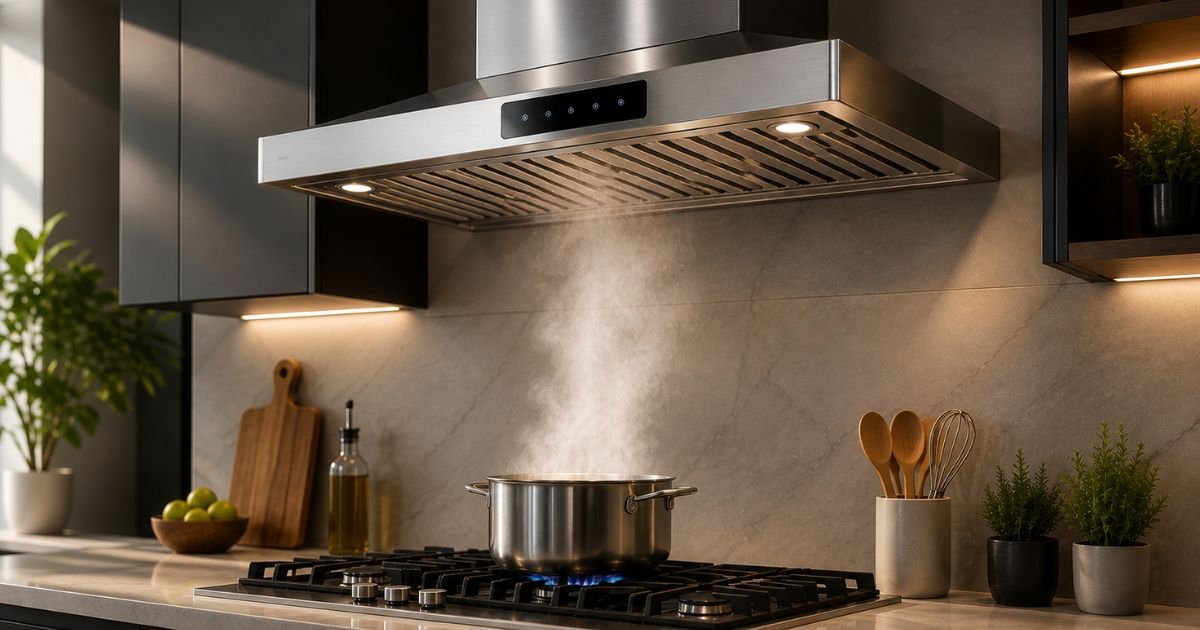
Apart from removing cooking smells, there is much more that a range hood in the kitchen accomplishes. Proper ventilation ensures that smoke, grease, heat, moisture, and particulates emitted while cooking do not get distributed around the house. It is important to note that selecting a range hood based on aesthetics or power alone can be detrimental.
The key measurement to understand is CFM, or cubic feet per minute. It indicates how much air a ventilation system can move. Choosing the correct Kitchen Range Hood CFM depends on several factors, including cooktop size, fuel type, cooking habits, hood location, and ductwork.
Airflow calculations can be helpful for homeowners looking to remodel their kitchens since this knowledge will help you choose an efficient venting system without over-sizing.
What Does Range Hood CFM Actually Mean?
Range Hood CFM refers to the volume of air a hood can move in one minute. A higher CFM rating generally means the hood can move more air, but higher is not automatically better.
For instance, the homeowner who uses the electric stovetop on an occasional basis may require less airflow than another individual who is cooking often on the high-output gas stovetop.
The Home Ventilating Institute (HVI) provides recommendations about required amounts of airflow depending on the hood’s placement. The institute recommends 40 to 100 CFM per linear foot of the wall-mounted hood and 50 to 150 CFM per linear foot of the island hood.
Therefore, it is necessary to select appropriate CFM, taking into account the cooking area.
Why Kitchen Ventilation Matters
Cooking produces more than just smells from the food. Based on ENERGY STAR, cooking may release particulates and moisture in the air inside the house. Cooking using gas may release toxins like carbon monoxide and nitrogen dioxide.
For this reason, ENERGY STAR recommends using a range hood that vents directly outdoors whenever cooking.
Effective Range Hood Ventilation can help:
- Capture smoke and cooking particles
- Reduce lingering odours
- Control excess moisture
- Limit grease accumulation on nearby surfaces
- Improve indoor air quality
- Prevent cooking pollutants from spreading
Hood size, however, is just one aspect of proper hood design. Duct configuration, hood positioning, and exhaust termination are other factors that impact performance.
How to Calculate the Right CFM
There is no single CFM number that works for every kitchen. A practical starting point is to consider the width and location of the cooking surface.
For wall-mounted hoods, HVI guidance uses a range of approximately 40–100 CFM per linear foot of cooktop. Island installations can require approximately 50–150 CFM per linear foot because they are exposed on multiple sides.
For example, consider a 30-inch cooktop installed against a wall.
Thirty inches equals 2.5 linear feet.
Using the HVI range:
2.5 × 40 = 100 CFM
At the higher end:
2.5 × 100 = 250 CFM
So, a wall-mounted hood for this example could fall within approximately 100–250 CFM depending on cooking intensity, hood design, and other project conditions.
An island cooktop of the same width would use the island guidance:
2.5 × 50 = 125 CFM
At the higher end:
2.5 × 150 = 375 CFM
This demonstrates why hood location matters when selecting ventilation capacity.
Gas Cooktops Need Special Attention
Fuel type is another important consideration. High-output gas ranges can generate significantly more heat than many standard electric cooking surfaces.
Broan-NuTone recommends, for high-output gas ranges or cooktops, a minimum of 1 CFM of ventilation per 100 BTU of cooking output.
For example, suppose a gas range has a combined output of 60,000 BTU.
The calculation would be:
60,000 ÷ 100 = 600 CFM
That provides a useful starting point for evaluating hood capacity.
However, homeowners should not rely on a single formula for every installation. Manufacturer requirements, local mechanical codes, makeup-air requirements, hood type, and duct design must also be considered.
Choosing the Right Range Hood Size
CFM is only one part of hood selection. Range Hood Size also matters because the hood needs enough capture area to collect rising smoke and heat effectively.
A hood should generally be at least as wide as the cooking surface, while some installations may benefit from additional coverage. HVI advises that hood width should match the cooking range and that the hood should be installed at the manufacturer-recommended height.
For example:
| Cooktop Width | Common Hood Width |
| 24 inches | 24–30 inches |
| 30 inches | 30–36 inches |
| 36 inches | 36–42 inches |
| 48 inches | 48 inches or larger |
These are practical planning ranges, not universal installation requirements. Always follow the hood manufacturer’s specifications.
A wider hood can provide better capture, but it must also fit properly within the cabinetry and kitchen layout.
Wall-Mounted vs. Island Ventilation
The location of the cooktop changes ventilation requirements.
A wall hood has the advantage of the wall behind the cooking surface since it aids in containing and directing the rising air to the hood. Island ranges lack this feature.
That is why HVI’s recommended airflow range is higher for island hoods than for wall-mounted installations.
Island installations may therefore require:
- Greater CFM
- Wider capture area
- Carefully planned ductwork
- Appropriate mounting height
- Stronger consideration of cooking habits
When planning a kitchen island with a cooktop, ventilation should be considered before cabinetry and ceiling details are finalized.
Ductwork Can Change Real-World Performance
A hood’s advertised CFM does not always equal the airflow delivered after installation.
Air must travel through the duct, and resistance can reduce performance. HVI notes that static pressure is affected by factors such as duct length, duct materials, bends, and the exterior termination.
This is why simply buying a high-CFM hood may not solve a ventilation problem.
During remodeling, designers and contractors should consider:
- Duct diameter
- Duct length
- Number of bends
- Exterior termination
- Duct material
- Hood configuration
Shorter, smoother duct runs generally make it easier for the ventilation system to move air effectively.
When Is a Kitchen Exhaust Fan Enough?
A dedicated Kitchen Exhaust Fan can provide useful ventilation, particularly in kitchens where a traditional hood is not practical. However, the system should be selected based on the kitchen layout and the cooking equipment.
The guidelines of ENERGY STAR for energy-efficient homes recommend the installation of kitchen mechanical exhaust that vents directly outside. The ENERGY STAR reference guide states that intermittent kitchen exhaust should be at least 100 CFM and considers other factors depending on kitchen volume and the type of system installed.
This is not to say that all kitchens need 100 CFM. This serves to show how ventilation should be considered within the entire kitchen system.
Understanding Vent Hood CFM for Different Cooking Styles
Cooking habits can have a major influence on the appropriate airflow level.
Homeowners cooking simple meals are likely to require very different airflow from the one that likes searing steaks, cooking on a wok, grilling indoors, and using more than one burner at a time.
A practical comparison looks like this:
| Cooking Style | Ventilation Consideration |
| Light electric cooking | Moderate airflow may be sufficient |
| Regular everyday cooking | Moderate to higher airflow |
| Frequent frying or searing | Higher airflow recommended |
| High-output gas cooking | Calculate based on BTU |
| Large island cooktop | Higher airflow and capture area |
The objective is effective capture rather than simply maximizing CFM.
Don’t Ignore Noise and Energy Efficiency
An effective hood is indeed helpful, but one also needs to keep in mind the issue of noise. A ventilation system that generates too much noise would definitely discourage the use of the same.
The criteria for an ENERGY STAR range hood at present take into account efficiency as well as sound ratings. The certified range hoods must be effective and also have sound performance.
When comparing models, check:
- Maximum CFM
- Sound rating
- Energy efficiency
- Number of speeds
- Filter design
- Duct configuration
- Manufacturer warranty
A multi-speed hood can be particularly useful because homeowners can use lower airflow for everyday cooking and increase ventilation when cooking produces more smoke or heat.
How to Improve Kitchen Smoke Ventilation
Even a correctly sized hood will perform poorly if it is not installed or used properly.
For better Kitchen Smoke Ventilation, homeowners should turn the hood on before or at the beginning of cooking rather than waiting until smoke has already spread through the room.
Other practical improvements include:
- Keep filters clean.
- Use the appropriate fan speed.
- Keep the hood positioned according to manufacturer instructions.
- Minimize unnecessary duct bends.
- Ensure the system vents outdoors when designed for exterior exhaust.
- Have ductwork professionally installed.
ENERGY STAR specifically recommends kitchen exhaust systems that discharge directly outdoors, helping remove cooking-generated pollutants at the source.
Do High-CFM Hoods Always Perform Better?
Not necessarily. A 1,000-CFM hood installed with restrictive ductwork may perform worse than a properly designed lower-CFM system with an efficient duct path.
High airflows can have additional implications, especially in tightly constructed homes. Excessive airflows can be a concern when it comes to the pressure balance in a house, and high CFM appliances may require make-up air. Due to the above-stated concerns, homeowners need to focus on their entire ventilation system rather than on the highest CFM rating of a particular hood.
A Simple CFM Planning Example
Consider a homeowner remodeling a kitchen with a 36-inch gas range rated at 60,000 BTU.
The range has:
60,000 ÷ 100 = 600 CFM
The BTU-based calculation suggests approximately 600 CFM as a starting point for a high-output gas installation under Broan-NuTone’s guidance.
Now consider a 36-inch electric cooktop installed against a wall.
The cooktop measures 3 linear feet.
Using HVI’s wall-mounted range of 40–100 CFM per linear foot gives:
3 × 40 = 120 CFM
to
3 × 100 = 300 CFM
This calculation will illustrate how the correct CFM requirement varies with regard to equipment, location of equipment, and level of cooking activity. A specialist should be consulted to finalize the choice.
Common Range Hood Selection Mistakes
Homeowners usually base their venting choices on aesthetics alone. There are some errors that lead to poor performance.
Choosing a hood that is not wide enough for the stovetop is one. Choosing a high-CFM hood without thinking about the duct size is another.
Other mistakes include:
- Ignoring manufacturer installation requirements
- Forgetting about duct routing during remodelling
- Choosing a hood solely by maximum CFM
- Overlooking sound ratings
- Neglecting filter maintenance
- Failing to consider makeup-air requirements where applicable
If these issues are taken care of beforehand, then it will prevent costly modifications once the cabinets and ceiling are put up.
Final Thoughts
Choosing the right Kitchen Range Hood is ultimately about matching ventilation capacity to the cooking equipment, kitchen layout, and household cooking habits.
Understanding Range Hood CFM makes it easier to compare models and avoid choosing a system that is either unnecessarily powerful or insufficient for the cooking environment. HVI guidance provides useful starting points based on hood location, while gas-range calculations can help evaluate high-output appliances.
These factors include hood size, ducting, noise levels, energy efficiency, height of the installation, and venting outdoors, in addition to CFM.
The ideal ventilation system is not the one with the highest value. According to Kitchen & Bath Resources, it is the one that captures cooking emissions, conforms to the duct layout of the house, and meets the requirements of how the kitchen is being used.
Frequently Asked Questions
1. How many CFM should a kitchen range hood have?
The suitable CFM varies depending on the size of the cooktop, the fuel source, the hood placement, and the cooking methods. HVI specifies different flow rates for wall and island hoods.
2. Is 400 CFM enough for a kitchen hood?
It will suffice in some kitchens, but high-capacity gas stoves or island stoves might need additional air. The specifications of the appliance and its installation will decide the exact amount required.
3. How do I calculate CFM for a gas range?
The formula for high-capacity gas cooking, according to one manufacturer, is to divide the total BTUs by 100. This would mean a 60,000 BTU appliance has 600 CFM.
4. Does a larger range hood need more CFM?
No, not necessarily. The width of the hood determines the capture area, but the CFM is dependent on the cooking equipment used, the location of the hood, and the cooking intensity.
5. Should a range hood vent outside?
Cooking pollutants should be eliminated through exhaust systems that vent outside the home, according to ENERGY STAR.