

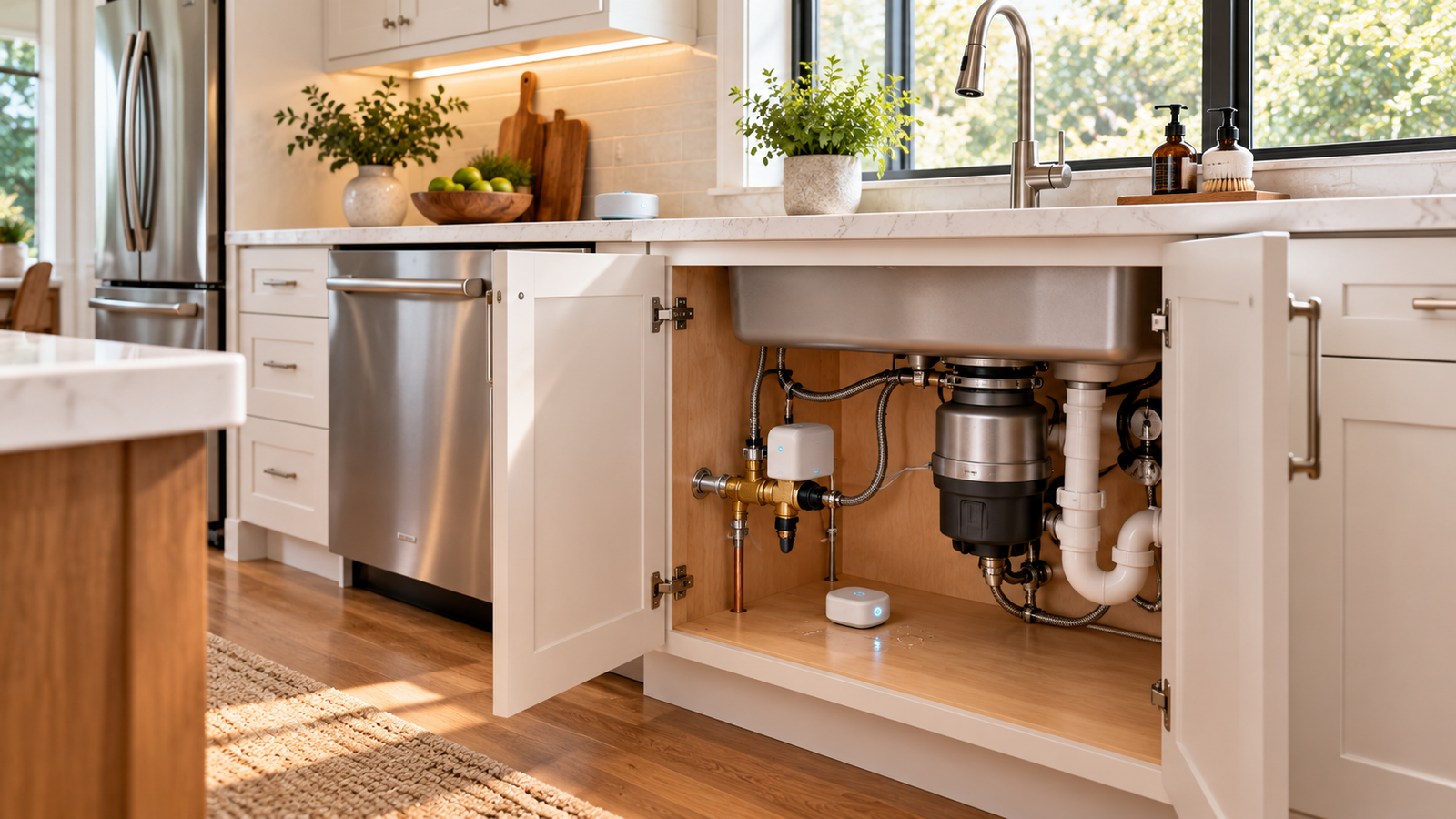
A slow leak beneath the kitchen sink can go unnoticed for weeks. Water may collect behind cleaning supplies, soak the cabinet floor or reach the flooring before anyone sees a puddle. A failed dishwasher supply connection can cause damage much faster.
Most homeowners plan their kitchen renovation around cabinets, countertops and appliances. Yet one of the most useful additions may be a small water sensor that is barely visible after installation.
The newly released National Kitchen & Bath Association (NKBA) 2027 Kitchen Trends Report puts this issue in focus. Published October 14, 2026, the report draws on feedback from 830 North American industry professionals. Industry coverage of its climate-resilience findings reports that 65% of surveyed designers agree on the importance of leak detection systems and automatic shutoff valves. This is a professional outlook, not a statistic showing that 65% of homeowners already own these devices.
There is also a practical reason to pay attention. The U.S. Environmental Protection Agency (EPA) published an updated consumer guide to leak detection and flow monitoring in February 2026, explaining how these systems can help identify unexpected water use and limit waste or damage.
So what should homeowners actually install? The answer depends on the plumbing layout, the level of protection needed and whether the system should simply sound an alarm or turn the water off automatically.
Why Water Leak Protection Belongs in a Kitchen Remodel
A renovated kitchen contains several possible sources of water leakage: the faucet connections, sink drain, garbage disposal, dishwasher, refrigerator ice-maker line, water filter and any under-sink drinking-water system.
Not all leaks are dramatic. A loose fitting may release small amounts of water that remain hidden behind the sink cabinet’s toe kick. A slow drip can damage cabinet components without creating an obvious pool on the kitchen floor.
New cabinetry may also conceal plumbing more completely than older kitchens. Pull-out organizers and full-height drawer fronts improve storage, but they can make a leak harder to notice unless the cabinet interior is checked.
The objective of leak detection is to shorten the time between the first sign of a problem and the homeowner’s response. A shutoff system can go further by stopping the supply of water to a fixture or the house when its triggering conditions are met.
Neither approach replaces proper plumbing installation or routine inspections.
Three Types of Kitchen Water Leak Protection
1. Point-of-Use Moisture Sensors
These compact devices sit where escaped water is likely to collect, such as on the cabinet floor beneath the sink. Their contacts detect moisture and trigger an audible alarm, phone notification or another configured response.
Some models are battery-powered and work independently. Others connect to a hub or home network.
A moisture sensor is a useful first step because it monitors a specific location without changing the plumbing. But a basic alarm-only sensor does not stop the water. Someone must hear or receive the alert and act.
2. Flow-Monitoring Systems
Flow-monitoring systems measure water movement or pressure patterns in the plumbing. Depending on the technology, they can identify unusual continuous flow, unexpected water use or other possible leak conditions.
These systems can monitor a broader area than one moisture sensor, but they may need configuration to distinguish a genuine leak from normal household activity.
A flow monitor does not necessarily detect every small leak, and a device without shutoff capability still depends on someone responding to the alert.
3. Automatic Water Shutoff Valves
Automatic shutoff systems connect a detection event to a valve that closes a water supply.
A point-of-use valve can protect a particular fixture or appliance. A whole-home valve can stop incoming water to the house when the system identifies a qualifying event.
Some systems combine a valve with flow monitoring. Others use separate moisture sensors that communicate with the valve.
EPA guidance distinguishes between alarm-only products and devices with automatic intervention. When evaluating a product, verify what actually triggers closure, which line is shut off and whether the system still operates during a power or internet outage.
Leak Detector vs. Automatic Shutoff: Quick Comparison
| Feature | Moisture Alarm | Flow Monitor | Automatic Shutoff System |
| Detects water on a surface | Yes, at sensor location | Not usually | Sometimes, with linked sensors |
| Detects unusual pipe flow | No | Yes, subject to sensitivity | Some models |
| Can stop water automatically | No, unless integrated | Only if paired with a valve | Yes, under configured conditions |
| Typical coverage | One risk location | Selected plumbing line or whole home | Fixture, appliance or whole home |
| Installation | Often simple | Depends on device | May require professional plumbing work |
| Main limitation | Only detects water that reaches the sensor | May miss some leaks or produce false alerts | Must be compatible, maintained and tested |
These are functional categories, not guarantees about every product. Read the exact model’s documentation before buying.
Where Should You Put Water Leak Detectors in the Kitchen?
Under the Sink
The sink base is usually the first location to consider. It may contain hot and cold supply connections, a drain trap, disposal connections and a filtration system.
Position a sensor on the lowest surface where leaked water is likely to collect. Avoid placing it on a shelf where a drip could pass underneath without touching it.
If a sink cabinet has an organizer, ensure the sensor will not be knocked out of place when the organizer moves.
Near the Dishwasher
A dishwasher has supply and drain connections that can leak. The most useful sensor location depends on whether escaped water would collect beneath the machine, emerge at the toe kick or flow toward an adjacent cabinet.
Because the appliance may be difficult to access after installation, discuss sensor placement with the installer before the dishwasher is fitted. Some systems use remote sensing cables or probes.
Do not obstruct the dishwasher’s required installation clearances or service access.
At the Refrigerator Water Line
If the refrigerator has an ice maker or water dispenser, inspect the supply connection and consider a detector near the connection or where water would first become visible.
The refrigerator’s location and the direction of floor slope affect where a sensor will be effective.
Beneath a Water Filter or Reverse-Osmosis System
Filters and reverse-osmosis equipment can add multiple fittings, tubing runs and storage components beneath the sink.
A sensor near the lowest likely collection point can be useful, but it should not replace correct tubing support, secure connections and scheduled filter maintenance.
Is Whole-House Shutoff Better Than a Sensor Under the Sink?
Whole-home shutoff and local sensors solve overlapping but different problems.
A whole-home valve can stop incoming supply water to multiple fixtures. That can be valuable if a pipe or appliance line fails while nobody is home.
A local moisture sensor can detect water at a precise location, including some leaks that a flow-monitoring device may not identify promptly.
For broader coverage, homeowners may combine an automatic main-line valve with sensors beneath the sink and near major appliances.
However, a whole-home shutoff does not prevent every type of water damage. It cannot stop rain entering through a roof, water already stored in an appliance, or a drain leak caused by water that is already in the sink. Depending on plumbing configuration, it may not protect against all sources of water.
The best approach begins by mapping the actual water sources and deciding what each device is expected to detect.
What to Plan Before Installing New Kitchen Cabinets
Leak protection is easier to coordinate when plumbing, electrical and cabinet plans are still being finalized.
Ask the kitchen designer and plumber to identify the location of shutoff valves, appliance supply lines, filtration equipment and service access.
If a motorized valve is planned, confirm there is sufficient space to install, maintain and manually operate it as specified by the manufacturer.
For systems requiring power, plan a compliant power source and cable route. Do not conceal plugs or components in locations prohibited by electrical or plumbing rules.
Consider whether a sensor will remain accessible once pull-out trash bins, drawer organizers and other cabinet accessories are installed.
Finally, label the home’s main water shutoff clearly. Smart controls are useful, but everyone in the household should know how to turn the water off manually.
Do You Need Wi-Fi for a Water Leak Detector?
Not necessarily.
Some leak alarms operate locally using batteries and an audible signal. Other systems communicate through Wi-Fi, a dedicated hub or a home automation protocol.
A connected device may provide remote alerts, usage history and control from a phone. Those features are convenient when traveling or managing a second home.
But connectivity adds responsibilities. Wi-Fi passwords change, routers fail, batteries run low and software may need updates.
EPA’s February 2026 guide advises owners of connected devices to verify that the connection remains active after outages or changes to their internet service.
When comparing models, ask what happens if the internet is unavailable. Does the local alarm still sound? Will a paired valve still close? Can the system be operated manually?
Choose the behavior you need rather than assuming every smart device works offline.
What Does an Automatic Water Shutoff Valve Cost?
There is no meaningful single price for every installation.
An inexpensive battery-powered moisture alarm is a different project from a whole-home monitoring valve installed in a tight mechanical room.
The total cost can depend on the device, number of sensors, plumbing access, pipe material, valve size, electrical requirements, subscription features and local labor.
Request an itemized estimate that separates equipment, plumbing modifications, commissioning and any recurring service fees.
The EPA’s 2026 guide notes that potential water savings are difficult to predict because leaks are unpredictable. Avoid promises that a device will automatically pay for itself within a specific number of months.
The value proposition is reducing the risk and duration of unnoticed leaks, not a guaranteed return on investment.
Can Leak Detectors Lower Home Insurance Costs?
Some insurers may offer incentives for approved water monitoring or automatic shutoff systems, but programs and eligibility differ.
Before purchasing a system for an insurance benefit, contact the insurer and ask which devices qualify, whether professional installation is required and what documentation must be submitted.
Do not assume that a smart sensor automatically earns a premium discount or that it eliminates coverage limitations.
A device may be worthwhile for peace of mind even when no discount is available.
Installation and Maintenance Checklist
A system only helps when it remains operational.
Before the kitchen is finished, confirm the installer has tested each sensor and any automatic valve response according to the manufacturer’s procedure.
For ongoing maintenance:
- Check batteries and low-battery alerts.
- Confirm sensors have not been moved by cleaning supplies or cabinet organizers.
- Inspect sensing contacts for dust and residue.
- Test alarms and valve operation at the intervals specified by the manufacturer.
- Confirm phone alerts reach the correct household members.
- Recheck internet-connected devices after router changes or outages.
- Inspect visible supply hoses, fittings and drains for signs of leakage.
If a device requires calibration, follow the product instructions. Do not repeatedly close a main water valve in a way that could interfere with other equipment or household systems.
For an in-line valve, use a qualified plumber and confirm local code requirements, water pressure considerations and compatibility with the home’s plumbing.
Five Mistakes to Avoid
Buying a Sensor Without Checking Where Water Will Travel
A sensor on the wrong side of a cabinet divider may never get wet during a leak. Place it where water would realistically collect.
Assuming Every Smart Alarm Shuts Off Water
Many products only notify. Confirm whether the system includes a valve and what triggers it.
Forgetting the Dishwasher and Refrigerator
The sink is an obvious location, but appliances with water connections also deserve attention.
Blocking Access With Cabinet Storage
A sensor hidden behind a permanently installed organizer is harder to test and replace.
Treating Leak Detection as a Substitute for Good Plumbing
Detection is a backup layer. Correct fittings, accessible shutoffs, appropriate appliance installation and timely repairs remain essential.
Frequently Asked Questions
Where is the best place to put a leak detector under a kitchen sink?
Place it on the lowest accessible surface where escaped water is likely to collect, taking account of the cabinet layout and plumbing connections. Test the position according to the device instructions.
Can a water leak sensor automatically shut off the water?
Only if it is part of a compatible automatic shutoff system. Basic moisture alarms may simply sound or send notifications.
Do automatic shutoff valves work without the internet?
Some systems have local controls or offline operating modes; others depend on network connectivity for particular functions. Check the model’s specifications and test the configured behavior.
Will a whole-house leak detector find every leak?
No. Detection depends on the technology, sensor coverage, settings and plumbing layout. Some leaks may not create a recognizable flow pattern or reach a moisture sensor.
Should I install leak detection during a kitchen renovation?
A renovation is a convenient time to plan sensor locations, valve access and power requirements. It can also be added to many existing kitchens, depending on the equipment selected.
Final Thoughts: Protect the Kitchen You Are Investing In
Kitchen design is increasingly about more than finishes. The NKBA’s newly released 2027 research places practical resilience features alongside the familiar priorities of storage, layout and materials.
A leak detector is not a glamorous upgrade, but it can provide useful warning when water appears where it should not. An automatic shutoff system may provide another level of protection by limiting the water supplied during a qualifying leak.
Start with the sink cabinet and water-connected appliances. Decide whether an alarm is sufficient or whether automatic shutoff makes sense for the household. Then coordinate the equipment with the plumber and kitchen installer before the new cabinetry closes everything in.
The most valuable kitchen improvements are sometimes the ones you hope never to notice.