

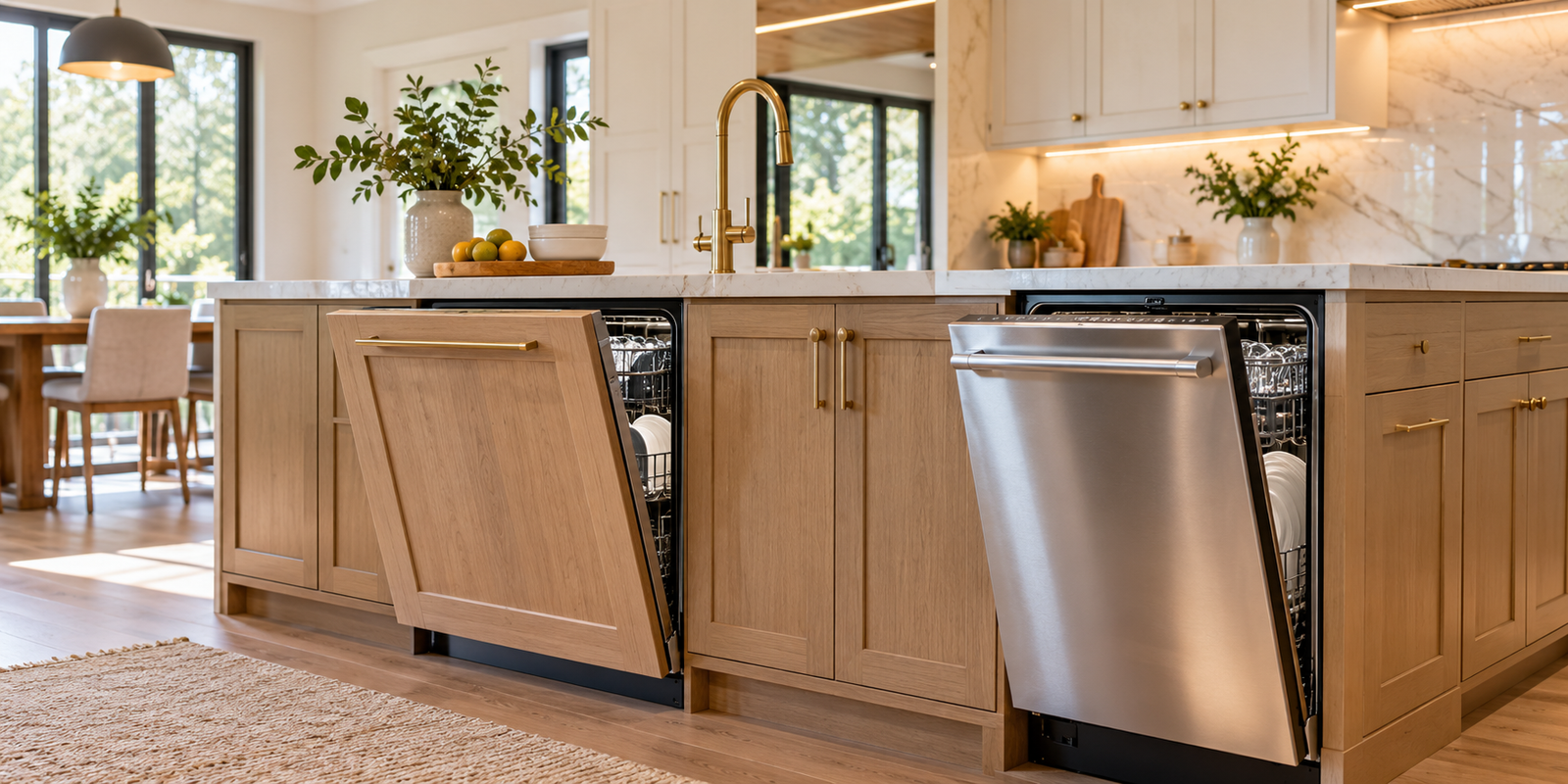
A dishwasher is one of the hardest-working appliances in a kitchen, yet its front panel can influence the entire room’s appearance. A stainless steel model makes the appliance visible and easy to identify. A panel-ready dishwasher can disappear into the cabinet run, using a matching door front to create a more continuous look.
The decision is not simply about style. A custom panel changes the ordering process, cabinet coordination, installation details and potentially the cost of replacing the dishwasher years later.
There is a timely reason to compare the two. The National Kitchen & Bath Association’s 2027 Kitchen Trends Report, released October 14, 2026, describes a shift toward purposeful, visually calmer kitchens. In coverage of the report, 85% of surveyed designers agreed that cabinetry is being designed to conceal appliances and functional elements. Meanwhile, the 2026 U.S. Houzz Kitchen Trends Study found that 72% of surveyed renovating homeowners who updated appliances chose stainless steel.
These are different surveys measuring different things: designers’ expectations versus homeowners’ selected appliance finishes. They do not establish that panel-ready dishwashers outsell stainless steel models. They do show why both approaches deserve consideration.
What Is a Panel-Ready Dishwasher?
A panel-ready dishwasher is built to accept a compatible custom decorative front, typically supplied by the cabinet manufacturer or a cabinetmaker. The panel can match adjacent cabinet doors in material, color, profile and hardware.
Many fully integrated models place the controls on the top edge of the door, hidden when it is closed. Some include a floor-projected status light or another indicator to show when a cycle is running.
A panel-ready appliance is not an ordinary stainless dishwasher with a cabinet door glued over it. The dishwasher must be specifically engineered for a decorative panel, with the correct mounting hardware and door-spring or hinge capacity.
An integrated appearance also depends on surrounding cabinet alignment, toe-kick design and the finished countertop height.
Panel-Ready vs. Stainless Steel: Quick Comparison
| Consideration | Panel-ready dishwasher | Stainless steel dishwasher |
| Appearance | Blends with cabinet fronts | Visible appliance finish |
| Door front | Separate compatible custom panel | Factory-finished front |
| Cabinet coordination | More detailed | Usually simpler |
| Installation | Panel weight, hinge and reveal checks | Standard appliance fit and hookups |
| Upfront budget | Appliance plus panel, hardware and fitting | Usually appliance and installation |
| Future replacement | New unit must suit opening and panel strategy | Often easier to replace with another standard-size model |
| Cleaning | Depends on cabinet finish and handle | Depends on stainless finish and handle |
| Wash performance | Depends on model specifications | Depends on model specifications |
Neither finish automatically makes a dishwasher quieter, more reliable or more efficient.
What the 2026 and 2027 Research Actually Says
The NKBA’s 2026 Kitchen Trends Report found that 85% of its surveyed industry professionals identified panel-faced dishwashers as gaining popularity. Its 2027 report, based on feedback from 830 North American professionals, identifies appliance concealment as part of a broader move toward intentional simplicity.
By contrast, the 2026 Houzz study, based on 1,780 U.S. homeowner respondents, found stainless steel was the leading appliance color at 72% among those updating appliances.
This is an important distinction for homeowners and designers. A feature can be widely anticipated by design professionals while a conventional finish remains the most common choice among actual renovators.
The best decision should follow the project’s budget, cabinet design and maintenance priorities rather than a prediction alone.
The Real Cost Difference
Panel-ready installations often cost more overall, but the difference cannot be reduced to a reliable universal percentage.
A complete estimate should include the dishwasher, compatible cabinet panel, handle or opening mechanism, any special hardware, cabinetmaker labor, appliance installation and adjustments to the surrounding toe kick.
If cabinetry is being made from scratch, a matching front may be relatively straightforward to specify. Retrofitting an existing kitchen can be harder if the original door style, stain or paint is no longer available.
Stainless steel usually avoids the custom-panel portion of the project. However, premium stainless models can cost more than entry-level panel-ready units, so compare equivalent washing, drying, sound and reliability features.
Ask for two itemized installed quotes rather than comparing appliance sticker prices alone.
Dishwasher Dimensions: Why the Exact Model Matters
Many North American built-in dishwashers are described as 24-inch models, and compact alternatives are commonly marketed as 18-inch models. Those are nominal categories, not guaranteed finished cutout dimensions.
The installation sheet for the selected dishwasher must determine the actual opening width, height, depth, leveling range, water connection, drain routing and electrical requirements.
As one illustration, a published 24-inch panel-ready dishwasher specification lists a required cabinet cutout of 24 inches wide and 24 inches deep, with a specified minimum height. Another model may differ, especially in an accessible-height or compact configuration.
Do not finalize the cabinet opening based solely on the words “24-inch dishwasher.”
Check the Panel’s Weight and Thickness
The custom door is a moving component supported by the dishwasher’s hardware. Excessive panel weight can affect how the door opens, closes and stays in position.
Manufacturer installation sheets may specify a permitted weight range, thickness and panel height. For example, one published custom-panel specification allows a defined panel-weight range and notes that spring adjustments may be needed outside the factory-prepared range.
Those figures are model-specific, not industry-wide allowances.
Cabinetmakers should receive the exact installation template before cutting or drilling the panel. A beautiful front that exceeds the manufacturer’s limits is not a successful installation.
Coordinate the Toe Kick and Door Swing
The dishwasher door must open fully without hitting the toe kick, floor or adjacent hardware.
Tall decorative panels and unusually low toe kicks can create interference. Some manufacturers offer sliding-hinge or other installation solutions, but compatibility must be confirmed before purchase.
Test the open-door position on the drawings, including the space a person needs to load the bottom rack.
A seamless closed-door appearance is not worth a door that catches on the floor.
Will the Cabinet Panel Match Perfectly?
It can, but matching is more involved than selecting the same paint color.
Consider the door profile, grain direction, finish sheen, panel thickness, reveal spacing and handle position. A flat slab panel is generally easier to visually integrate than a detailed door with rails and stiles, although both may be possible with the right specifications.
Wood can change appearance with light and age. A replacement panel ordered years later may not match older cabinets exactly.
A painted finish can be touched up more easily in some cases, but color variation and surface wear are still possible.
If the kitchen uses a distinctive custom finish, keep the original finish formula and cabinetmaker records with the appliance documentation.
Cleaning and Moisture Protection
Stainless steel fronts may show fingerprints and water marks, depending on the finish. Fingerprint-resistant finishes can reduce visible smudges, but their cleaning requirements vary.
A matching cabinet panel may hide fingerprints better or worse depending on whether it is matte, glossy, textured or painted.
The cabinet panel also needs to tolerate routine exposure to moisture around the dishwasher. Use a finish and edge treatment approved for that location and follow the appliance’s steam, ventilation and installation instructions.
Do not cover required vents, block the door’s operating clearance or add decorative trim where the manufacturer prohibits it.
The most durable choice is a correctly installed assembly, not simply the material that looks easiest to wipe.
Are Panel-Ready Dishwashers as Quiet and Efficient?
They can be, but panel-ready construction alone does not guarantee better sound insulation or cleaning performance.
Compare the appliance’s published sound level in decibels (dBA), rack configuration, drying system, wash cycles and independently verified efficiency.
As of October 2026, the current ENERGY STAR criteria for standard residential dishwashers include a maximum of 240 kWh per year and 3.2 gallons of water per cycle under the applicable test procedure. Compact models have separate limits.
ENERGY STAR certification is tied to the actual appliance model, not whether its front is stainless steel or cabinetry.
The federal EnergyGuide label can help compare estimated operating costs. For Canadian buyers, consult the relevant EnerGuide information and local efficiency listings.
A quieter dishwasher can be particularly valuable in an open-plan kitchen, but the advertised sound rating should be considered alongside washing and drying performance.
How to Plan a Panel-Ready Dishwasher With Your Cabinet Designer
Step 1: Choose the Appliance First
Select the exact model before the cabinet drawings are approved. Obtain its current installation instructions, not just a retailer’s dimensions.
Step 2: Confirm the Panel Specification
Give the cabinetmaker the manufacturer’s permitted panel width, height, thickness, weight and mounting template. Confirm whether the handle is supplied separately.
Step 3: Review Adjacent Cabinets
Check door reveals, end panels, toe-kick height, drawer handles and the alignment of horizontal cabinet lines.
Step 4: Coordinate Plumbing and Electrical Work
Confirm the required supply, drain and electrical connections with qualified installers. Follow the locally adopted code and the product instructions.
Step 5: Test Door Operation
Before accepting the installation, open the door fully, load the racks, close the door and check that the panel clears the floor and neighboring cabinets.
Step 6: Keep Replacement Records
Save the dishwasher model number, installation drawings, panel dimensions, finish information and hardware details. These records can prevent costly guesswork when the appliance eventually needs replacement.
When Stainless Steel Is the Better Choice
Stainless steel is often practical when the existing kitchen already has visible stainless appliances, the homeowner wants a straightforward replacement or matching custom cabinetry is difficult.
It can also make sense in rental properties and projects where serviceability and replacement flexibility take priority over visual concealment.
A stainless dishwasher does not necessarily make a kitchen feel cluttered. In a balanced design, it can complement a range, refrigerator and metal hardware.
Choose a finish that coordinates with the room, then prioritize performance and installation quality.
When Panel-Ready Is Worth Considering
Panel-ready is most compelling during a full cabinet renovation, particularly when the design emphasizes continuous wood fronts, minimal visual interruptions or an integrated kitchen wall.
It can also work well when the dishwasher sits in a prominent location visible from the living room.
The strongest case is a homeowner who values the appearance enough to budget for the custom front and accepts the extra coordination involved.
It is less appealing when the cabinet finish is hard to reproduce, replacement flexibility is a major concern or the panel cost would displace more important upgrades.
Seven Mistakes to Avoid
- Ordering the panel before selecting the dishwasher. Panel requirements are model-specific.
- Assuming all 24-inch units are interchangeable. Cutout heights, depths and door systems vary.
- Ignoring panel weight. An incompatible panel can compromise door operation.
- Forgetting the toe kick. The decorative front must clear the floor when open.
- Comparing finishes instead of performance. Sound, cleaning, drying and efficiency depend on the model.
- Overlooking future replacement. Record panel dimensions and finish details.
- Treating a cabinet panel as waterproof. Moisture-resistant finishes and proper installation still matter.
Frequently Asked Questions
Can you put a cabinet panel on any dishwasher?
No. Use a model specifically designated as panel-ready or approved for a compatible decorative front. Do not improvise a panel on a standard dishwasher.
Are panel-ready dishwashers more expensive?
The complete installed project often costs more because the custom panel and fitting are additional work. Compare itemized quotes for the specific models and cabinetry.
Are panel-ready dishwashers standard size?
Many are sold in nominal 24-inch and compact categories, but exact cutout, panel and toe-kick requirements vary. Always use the model’s installation drawings.
Can you reuse a panel when replacing the dishwasher?
Sometimes, but only if the new appliance supports the existing panel’s dimensions, weight, attachment system and door movement. Never assume compatibility.
Is stainless steel going out of style?
The 2026 Houzz study found stainless steel remained the most selected appliance finish among surveyed renovating homeowners. Design professionals also anticipate more concealed appliances. Both approaches remain relevant.
Do panel-ready dishwashers clean better?
No inherent cleaning advantage comes from the exterior panel. Compare wash performance, drying, racks, sound and efficiency by model.
Final Thoughts
A panel-ready dishwasher can give a kitchen a quieter visual rhythm, especially when it is designed together with the cabinetry. Stainless steel remains a practical, widely selected finish that can simplify installation and future replacement.
The 2027 design outlook favors concealed function, but that does not make integrated appliances the right choice for every home.
Select the dishwasher for how well it cleans, dries, fits and can be serviced. Then decide which front best supports the kitchen design and budget.
The most successful dishwasher is the one that works beautifully—whether you notice it or not.