
Kitchen storage is changing. Homeowners are no longer asking only for more cabinets; they are looking for dedicated spaces that make everyday routines easier, keep clutter out of sight, and allow the main kitchen to stay visually clean.
That shift is helping two pantry types gain attention in North American kitchen design: the butler’s pantry and the walk-in pantry.
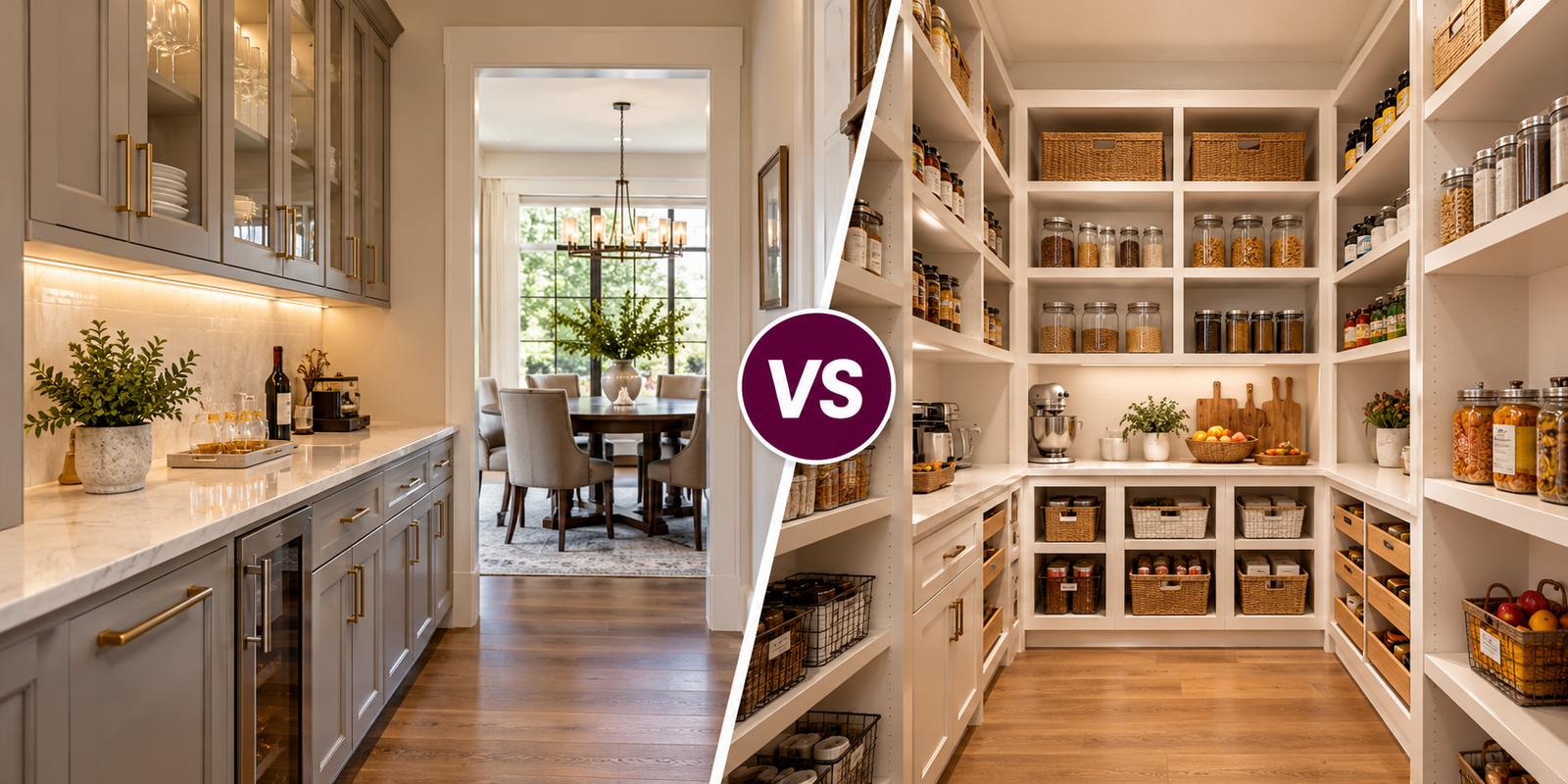
Both can add valuable storage, but they solve different problems. A walk-in pantry is primarily designed to organize food, bulk goods, small appliances, and household supplies. A butler’s pantry goes further by creating a secondary work zone that may include counters, cabinetry, outlets, appliances, beverage equipment, and sometimes a sink.
Current renovation data shows why the distinction matters. According to the 2026 U.S. Houzz Kitchen Trends Study, 76% of renovating homeowners add specialty built-in features. Pantry cabinets lead at 47%, while 16% add walk-in pantries and 7% add a butler’s pantry or prep kitchen. Among homeowners adding or upgrading a butler’s pantry, 67% include small-appliance storage, 61% add a prep counter, and 59% incorporate enclosed cabinetry.
| 2026 U.S. Houzz Kitchen Trends Study | Share |
| Renovating homeowners who add specialty built-in features | 76% |
| Pantry cabinets | 47% |
| Walk-in pantries | 16% |
| Butler’s pantry or prep kitchen | 7% |
The National Kitchen & Bath Association’s 2026 trend research points in the same direction: homeowners increasingly want smarter storage, adjoining pantries, reduced visual clutter, and clearer separation between primary and secondary kitchen functions.
So which option is right for your remodel? The answer depends on how you cook, entertain, store food, and use your kitchen every day.
What Is a Walk-In Pantry?
A walk-in pantry is a separate storage room, typically located next to or near the kitchen. Its primary purpose is organization.
Depending on its size, a walk-in pantry may contain:
- Open or closed shelving
- Pantry cabinets
- Pull-out baskets or drawers
- Bulk-food storage
- Small-appliance storage
- Beverage and snack zones
- Countertop space
- Household supplies
- Extra refrigerator or freezer space
For many households, the biggest advantage is visibility. Instead of distributing food across several kitchen cabinets, pantry items can be organized in one dedicated location.
A well-designed walk-in pantry can reduce clutter in the main kitchen and free valuable cabinetry for cookware, dishes, and everyday tools.
What Is a Butler’s Pantry?
A butler’s pantry traditionally served as a transitional space between the kitchen and dining room, used for storing tableware and preparing meals for service.
Modern versions are far more versatile.
Today’s butler’s pantry may include:
- Base and wall cabinetry
- Prep countertops
- Small appliances
- Coffee or beverage equipment
- Microwave
- Refrigerator or beverage refrigerator
- Dishwasher
- Sink
- Serving ware
- Dish and glass storage
- Open shelving
- Charging outlets
- Task lighting
In many homes, it functions almost like a compact second kitchen.
This is particularly useful in open-concept homes, where homeowners want the main kitchen to remain attractive while messier prep work, appliances, food packaging, and cleanup happen somewhere less visible.
Butler’s Pantry vs. Walk-In Pantry: The Main Difference
The simplest distinction is this:
A walk-in pantry is primarily a storage space. A butler’s pantry is primarily a storage-and-work space.
That difference influences almost every design decision.
A walk-in pantry prioritizes shelf capacity, visibility, organization, and access. A butler’s pantry requires more consideration of countertops, electrical outlets, plumbing, lighting, appliance clearances, ventilation, and workflow.
| Feature | Walk-In Pantry | Butler’s Pantry |
| Primary role | Storage space | Storage-and-work space |
| Design priorities | Shelf capacity, visibility, organization and access | Countertops, electrical outlets, plumbing, lighting, appliance clearances, ventilation and workflow |
For homeowners deciding between the two, the first question should therefore be: Do you mainly need more storage, or do you need a second place to perform kitchen tasks?
Why Walk-In Pantries Remain Popular
The biggest strength of a walk-in pantry is straightforward: it can store a lot without turning the main kitchen into a wall of cabinetry.
Houzz reports that walk-in pantries appear in 16% of current kitchen renovations, while NKBA research continues to identify walk-in and butler’s pantries as part of the broader movement toward smarter kitchen storage.
Better Food Organization
A dedicated pantry makes it easier to group canned goods, snacks, baking supplies, grains, beverages, and household staples by category.
Shallow shelving is often more useful than extremely deep shelves because products remain visible instead of disappearing behind one another.
Bulk Storage
Families that shop at warehouse clubs or buy staples in larger quantities may benefit considerably from a walk-in pantry. Paper goods, drinks, bulk ingredients, and backup products can stay out of the working kitchen.
Flexible Storage
Unlike fixed cabinetry, pantry shelving can often be adjusted as household needs change.
A young family might initially dedicate a section to snacks and lunch supplies. Years later, the same space could be reorganized for baking, entertaining, or specialty cookware.
Lower Complexity
A pantry used mostly for dry storage generally requires less infrastructure than a working butler’s pantry. That can simplify the remodel when plumbing or extensive electrical changes are unnecessary.
Why Butler’s Pantries Are Growing in Importance
Although butler’s pantries appear in a smaller share of renovations, the features homeowners put inside them reveal why these spaces are strategically important.
According to Houzz, among newly added or upgraded butler’s pantries:
| Feature in Added or Upgraded Butler’s Pantries | Share |
| Small-appliance storage | 67% |
| Prep counter | 61% |
| Enclosed cabinetry | 59% |
| Open shelving | 52% |
| Microwave | 29% |
| Refrigerator | 29% |
| Coffee machine | 28% |
| Toaster | 25% |
These are not simply storage closets. They are becoming functional extensions of the kitchen.
They Keep Small Appliances Off the Main Counter
Coffee machines, air fryers, mixers, blenders, and toasters can quickly dominate countertop space.
A butler’s pantry allows frequently used appliances to remain plugged in and accessible without making the main kitchen feel crowded.
They Create Secondary Prep Space
A countertop in a butler’s pantry can handle coffee preparation, baking, drink service, school lunches, or food staging during parties.
This can be particularly valuable when several people use the kitchen at the same time.
They Support Entertaining
For homeowners who regularly host guests, the butler’s pantry can serve as a staging area between the kitchen and dining space.
Serving dishes can be prepared away from guests, beverages can be organized separately, and used dishes can temporarily move out of the main entertaining area.
They Reduce Visual Clutter
NKBA’s current research emphasizes reduced visual clutter and clearer separation between primary and secondary functions. A butler’s pantry directly supports that goal by moving utilitarian activities away from the visible kitchen.
Is a Prep Kitchen the Same as a Butler’s Pantry?
The terms sometimes overlap, but a prep kitchen usually goes further.
A traditional butler’s pantry may focus on storage, serving, beverages, and light food preparation. A true prep kitchen—or what is sometimes called a back kitchen, dirty kitchen, or working pantry—may include a sink, dishwasher, refrigerator, full cooking capability, ventilation, and extensive countertops.
In large custom homes, this secondary kitchen allows the primary kitchen to function almost like a social and presentation space.
Before adopting the terminology, focus on function. The room should be designed around what the household actually needs rather than around a trend label.
Which Is Better for Everyday Storage?
For pure storage capacity, a walk-in pantry usually wins.
It works especially well for households with:
- Large grocery inventories
- Bulk purchases
- Children’s snacks
- Baking supplies
- Extra cookware
- Small appliances used occasionally
- Household products
The key is to design shelves intentionally.
Deep shelves may seem to provide more storage, but they can make small packages difficult to find. Combining shallower eye-level shelves with deeper lower shelving, drawers, baskets, and vertical dividers usually creates a more usable pantry.
Which Is Better for Small-Appliance Storage?
For appliances used every day, the butler’s pantry is generally more convenient.
Houzz’s finding that 67% of upgraded butler’s pantries contain small-appliance storage reinforces how central this function has become.
If the room has adequate outlets and countertop space, appliances can stay ready for use rather than being lifted in and out of cabinets.
However, appliances produce heat, steam, and electrical loads. Always follow appliance specifications and applicable electrical and ventilation requirements when designing enclosed or secondary work areas.
Which Is Better for Entertaining?
A butler’s pantry typically offers more value for homeowners who entertain frequently.
Consider a layout with:
- Beverage refrigerator
- Coffee machine
- Glassware storage
- Serving counter
- Sink
- Ice maker
- Dishwasher drawer
- Wine storage
Guests can access drinks without entering the main cooking zone, while hosts gain another surface for plating and staging.
For occasional entertainers who mainly need extra storage, a walk-in pantry may still be the more practical investment.
Open Shelves vs. Enclosed Cabinetry
Both pantry types can use a mix of open and closed storage.
Open shelving makes products easy to see and is often economical. It works particularly well for frequently used food items, baskets, and labeled containers.
Enclosed cabinetry hides visual clutter and protects the calm appearance many homeowners now prefer.
Houzz found enclosed cabinetry in 59% of upgraded butler’s pantries, while NKBA research points toward a broader preference for reduced visual clutter.
A balanced approach often works best: open storage where visibility matters and closed cabinetry where appearance matters more.
Electrical Planning Is Easy to Overlook
If your pantry will contain appliances, plan outlets before cabinetry is finalized.
A coffee maker, microwave, refrigerator, mixer, toaster, and charging station can quickly change electrical requirements.
Consider appliance locations, cord lengths, dedicated circuits where necessary, countertop clearances, lighting, and local electrical codes during the design phase rather than after cabinets are installed.
Should You Add a Sink?
A sink can transform a butler’s pantry into a much more independent work zone.
It can simplify:
- Beverage preparation
- Coffee cleanup
- Produce washing
- Food prep
- Entertaining
- Dish staging
However, adding plumbing increases complexity and cost.
If the main kitchen sink is only a few steps away, a second sink may not provide enough benefit to justify the work. For a larger butler’s pantry positioned between the kitchen and entertaining area, it can be far more useful.
What If You Don’t Have Room for Either?
Not every kitchen can dedicate an entire room to storage.
Fortunately, many of the same benefits can be created with cabinetry.
Houzz reports pantry cabinets as the most popular specialty built-in feature, used by 47% of homeowners incorporating specialty built-ins.
Alternatives include:
- Floor-to-ceiling pantry cabinets
- Pull-out pantry units
- Appliance garages
- Tall cabinets with roll-out shelves
- Beverage centers
- Built-in breakfast stations
- Cabinet walls with hidden doors
For smaller homes, a well-designed pantry cabinet can sometimes provide better accessibility than an undersized walk-in room.
Questions to Ask Before Choosing
Before deciding between a butler’s pantry and walk-in pantry, answer these questions:
1. What problem are you trying to solve?
If food storage is the primary issue, prioritize pantry capacity. If countertop clutter and workflow are the bigger problems, consider a butler’s pantry.
2. How often do you entertain?
Frequent hosts may benefit more from serving space, beverage refrigeration, and a secondary sink.
3. Which appliances do you use every day?
Appliances used daily need accessible surfaces and outlets. Appliances used a few times each month may simply need organized storage.
4. How much square footage can you dedicate?
Do not sacrifice an efficient main kitchen simply to create a pantry. The entire floor plan should work together.
5. Do you want storage visible or concealed?
This will influence whether you choose open shelving, enclosed cabinetry, a hidden pantry entrance, or some combination.
Butler’s Pantry vs. Walk-In Pantry: Quick Comparison
Choose a Walk-In Pantry If You Primarily Want:
- Maximum food storage
- Bulk-product organization
- Flexible shelving
- Less cabinetry in the main kitchen
- A dedicated location for household supplies
Choose a Butler’s Pantry If You Primarily Want:
- Secondary prep space
- Small-appliance storage
- Beverage or coffee service
- Entertaining support
- Additional countertops
- Concealed kitchen activity
- Optional sink or extra appliances
Consider Pantry Cabinetry Instead If:
- Square footage is limited
- You want storage inside the kitchen footprint
- You prefer everything close to the primary work area
- A separate pantry room would reduce usable kitchen space
Final Thoughts
The growing popularity of pantries reflects a larger change in how homeowners think about kitchen design.
The goal is no longer simply to fit more items into cabinets. It is to decide where different activities should happen and then design storage around those routines.
A walk-in pantry excels at organized storage. A butler’s pantry adds another layer by becoming an active workspace. Pantry cabinetry can deliver many of the same advantages when square footage is limited.
Current research from Houzz and NKBA suggests that homeowners increasingly value kitchens with specialized storage, secondary work areas, and fewer items left visible on the main counter.
The best pantry, therefore, is not necessarily the largest or most luxurious one.
It is the one that removes friction from your everyday routine.
Before adding a walk-in pantry or butler’s pantry to your remodel, make a list of everything you currently struggle to store, every appliance that crowds your countertops, and the tasks that create congestion in your kitchen. Those answers will tell you far more about the right solution than any trend photograph ever could.
Related Reading
- Butler’s Pantry vs. Walk-In Pantry: Which Is Better for Your Kitchen?
- Why Beverage Stations Are Becoming a Must-Have Kitchen Feature in 2026
- Pull-Out Shelves, Lazy Susans & Appliance Garages: The Best Hidden Kitchen Storage Ideas
- Space-Saving Kitchen Cabinet Ideas for Small Homes
Sources
- 2026 U.S. Houzz Kitchen Trends Study
- National Kitchen & Bath Association 2026 Kitchen Trends Report
- NKBA research presented at KBIS 2026