

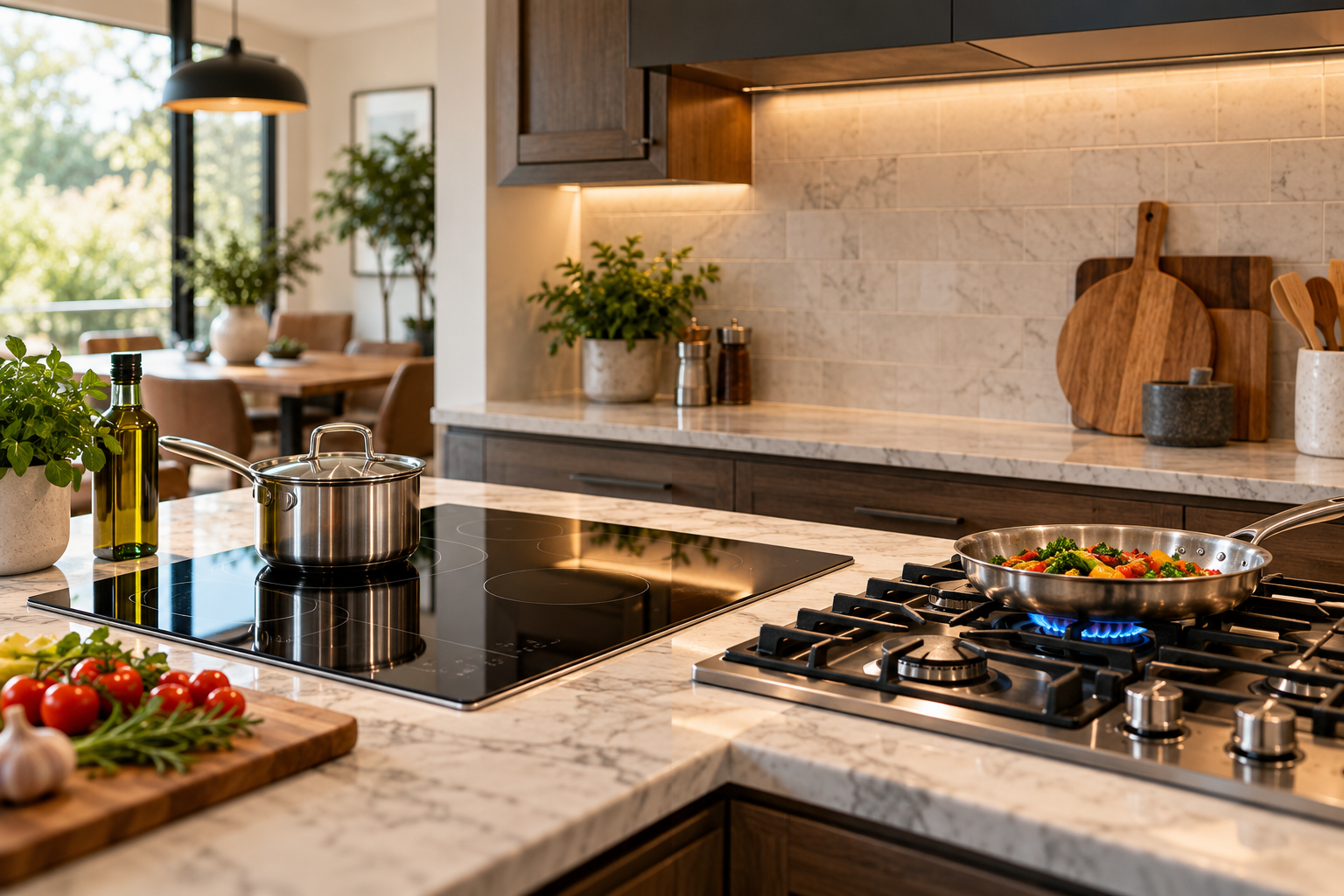
Choosing a cooktop used to be relatively straightforward: many homeowners picked gas for responsive heat or a conventional electric surface for simplicity. Kitchen remodeling in 2026 presents a more interesting choice. Induction has become a serious alternative, offering fast heating, precise control, a smooth surface and strong energy performance.
The National Kitchen & Bath Association’s 2026 Kitchen Trends research identifies smart technology, health and wellness, seamless design and material sophistication among the themes shaping kitchens. At the same time, ENERGY STAR now certifies qualifying residential electric cooking products, giving homeowners another way to compare efficiency when shopping.
So should you choose induction or stay with gas?
There is no universal answer. The better choice depends on how you cook, your home’s electrical and gas infrastructure, ventilation, cookware, budget and remodeling goals.
Here is what homeowners should understand before making the decision.
How Does an Induction Cooktop Work?
Induction looks similar to a smooth electric cooktop, but the heating method is different.
Instead of heating an element that then transfers heat to a pan, induction uses electromagnetic energy to generate heat in compatible cookware. The cookware effectively becomes part of the heating system.
This direct energy transfer is one reason induction responds quickly when you increase or decrease the power.
ENERGY STAR reports that roughly 85% of heating energy with induction is transferred to what is inside the cookware, compared with about one-third for gas cooking. The U.S. Department of Energy also notes that induction can be up to three times more efficient than gas and up to 10% more efficient than conventional smooth-top electric cooking.
| Efficiency Comparison | Figure | Source |
| Heating energy transferred to cookware contents — induction | Roughly 85% | ENERGY STAR |
| Heating energy transferred to cookware contents — gas | About one-third | ENERGY STAR |
| Induction vs. gas | Up to three times more efficient | U.S. Department of Energy |
| Induction vs. conventional smooth-top electric | Up to 10% more efficient | U.S. Department of Energy |
| ENERGY STAR-certified electric cooking vs. standard models | On average 18% more efficient | ENERGY STAR |
That efficiency is not just about utility consumption. Less wasted heat also means less heat released into the kitchen.
How Gas Cooking Works
Gas cooktops create heat through combustion. A burner produces an open flame that heats the cookware from underneath.
Many experienced cooks appreciate gas because the flame provides immediate visual feedback. Turn the control and you can see the flame change instantly.
Gas also works with a very broad range of cookware, which makes it familiar and flexible.
However, combustion means some energy heats the surrounding air rather than the pan. It also means kitchen ventilation deserves careful attention.
The U.S. Environmental Protection Agency notes that combustion appliances can contribute pollutants indoors and recommends outdoor-vented exhaust over gas stoves. Importantly, cooking itself can produce particulate matter regardless of fuel type, especially during frying, grilling, sautéing or when food burns. A good range hood therefore remains useful whether the cooktop is gas or induction.
Induction vs. Gas: Cooking Speed
For homeowners who prioritize speed, induction has a clear practical advantage.
ENERGY STAR says induction provides the fastest cooking time among cooking technologies and can boil water in as little as two minutes under suitable conditions. The Department of Energy also cites testing showing that induction can boil water substantially faster than gas and traditional electric cooktops.
Why?
With gas, heat must travel from the flame through the air and cookware before reaching the food. Induction transfers energy directly into compatible cookware.
This difference is particularly noticeable when boiling pasta water, heating large pots or bringing liquids rapidly to temperature.
Gas is certainly capable of powerful cooking, particularly with high-output burners. But high burner output does not automatically mean more of that energy reaches the food.
Which Offers Better Temperature Control?
This is where the old assumption that gas is always more responsive deserves reconsideration.
Gas remains intuitive because cooks can see the flame. Experienced users can make quick adjustments without looking at a display.
Modern induction, however, can change power rapidly because there is no traditional heating element that must slowly warm up or cool down. This makes it well suited to tasks requiring controlled heat, from simmering sauces to melting chocolate.
The experience feels different. Gas offers physical flame feedback; induction offers fast electronic control.
Homeowners who have cooked on gas for decades may need a short adjustment period before induction feels natural.
Energy Efficiency: Induction Has the Advantage
Energy efficiency is one of induction’s strongest arguments.
ENERGY STAR states that about 85% of induction heating energy is transferred to the contents of the cookware. It also says ENERGY STAR-certified electric cooking products are, on average, 18% more efficient than standard models.
This does not mean every homeowner will see dramatic utility-bill savings from changing the cooktop alone. Cooking represents only part of household energy use, and actual costs depend on local gas and electricity rates, cooking frequency and appliance performance.
But from a cooking-energy standpoint, induction wastes substantially less heat than gas.
For homeowners planning broader electrification or energy-efficiency upgrades, induction can also fit naturally into an all-electric kitchen strategy.
What About Indoor Air Quality?
This question has become increasingly important in kitchen planning.
Gas cooking involves combustion. The Department of Energy notes that burning gas can produce pollutants including nitrogen oxides, carbon monoxide and formaldehyde.
EPA guidance also makes an important broader point: cooking itself creates indoor particulate matter. Frying, grilling, sautéing, cooking fats and burned food can all increase indoor PM.
That means switching to induction does not eliminate the need for ventilation.
A well-designed kitchen should still include effective ventilation that captures moisture, grease, smoke and particles near the cooking surface. EPA recommends using a range hood while cooking and venting it outdoors where possible.
For homeowners choosing gas, proper ventilation is especially important because the kitchen must manage both cooking emissions and combustion byproducts.
Is Induction Safer Than Gas?
Induction offers several practical safety advantages.
Because induction requires compatible cookware to create heat, there is no open flame. ENERGY STAR notes that the cooktop surface does not heat in the same way as conventional cooking surfaces when no pan is present.
However, calling an induction surface “cold” would be misleading. A hot pan transfers heat back to the glass, so the area can remain hot after cooking.
Many induction models also include pan detection, automatic shutoff and control-lock features.
These characteristics can be attractive in households with children, older adults or anyone interested in reducing exposure to an open flame.
Gas appliances can also be used safely when correctly installed, maintained and ventilated. The difference is that gas introduces combustion and an exposed flame into the cooking environment.
Does Induction Require Special Cookware?
Possibly—but you may already own compatible cookware.
Induction requires magnetic cookware. Cast iron, enameled cast iron and many stainless-steel pots and pans work well.
An easy test is to place a magnet against the bottom of a pan. If it sticks firmly, the cookware is generally suitable for induction.
Some aluminum, copper, glass and nonmagnetic stainless-steel cookware will not work unless the product includes an induction-compatible magnetic base.
| Generally Works With Induction | May Not Work Without a Magnetic Base |
| Cast iron | Some aluminum |
| Enameled cast iron | Copper |
| Many stainless-steel pots and pans | Glass |
| Nonmagnetic stainless steel |
Before replacing an entire cookware collection, test what you already have.
Also check pan dimensions. Induction models can have minimum pan-size requirements, and certain flexible-zone cooktops behave differently with oversized or unusually shaped cookware.
Cleaning: Induction Is Simpler
Gas cooktops typically have grates, burner caps and recessed areas that collect grease and spills.
Induction usually provides a flat glass-ceramic surface that can be wiped down once it is safe to clean.
Because the cooktop itself does not generate heat in the same way as a radiant electric element, spilled food may be less likely to bake aggressively onto the surface. Hot cookware can still heat the glass, so spills should not simply be ignored.
For homeowners who cook frequently and dislike dismantling burner components, easier cleanup can become one of induction’s most noticeable everyday benefits.
Installation: This May Decide the Choice
Performance comparisons are only half the story. Remodeling infrastructure can determine what is practical.
Switching From Gas to Induction
A full-size induction cooktop or range may require a dedicated 240-volt circuit and sufficient electrical capacity. Exact requirements vary by appliance.
If the existing kitchen does not have the correct circuit—or the electrical panel lacks capacity—the project may require electrical work.
Before ordering the appliance, have a qualified electrician review:
- appliance specifications
- circuit requirements
- panel capacity
- wiring
- breaker size
- local electrical code requirements
Do not assume an existing standard outlet can support a full-size induction range.
Installing or Keeping Gas
Gas appliances require an appropriate gas connection and safe installation. Moving the cooking zone can increase project complexity if the gas line also needs to move.
Ventilation, clearances and local code requirements should be reviewed during design rather than after cabinetry is installed.
This is why cooktop selection should happen relatively early in a kitchen remodel.
Do You Still Need a Range Hood With Induction?
Yes.
Induction avoids combustion emissions at the cooktop, but it does not stop food from creating grease, steam, odors and airborne particles.
EPA specifically notes that cooking methods such as frying, grilling, baking and sautéing can increase indoor particulate matter.
A properly designed range hood can capture contaminants close to their source.
The hood should be selected around the cooking surface, kitchen layout, cooking habits and installation requirements—not simply because the cooktop is gas or electric.
Induction and Modern Kitchen Design
There is another reason induction fits current kitchen design: visual simplicity.
NKBA’s 2026 Kitchen Trends Report points toward seamless design, smart technology integration and minimalist features. Induction surfaces align naturally with that direction because they can sit nearly flush with a countertop and visually recede when not in use.
Some newer kitchen concepts go further with integrated ventilation, flexible cooking zones and increasingly discreet appliance design.
Gas, meanwhile, can provide a very different aesthetic. Large burners, metal grates and professional-style ranges can become intentional visual focal points in traditional, transitional or chef-inspired kitchens.
Neither aesthetic is inherently better. They serve different design goals.
Induction vs. Gas: Quick Comparison
Choose Induction If You Prioritize:
- fast heating
- high energy efficiency
- smooth, easy-to-clean surfaces
- precise electronic control
- no open flame
- reduced combustion inside the kitchen
- minimalist appliance design
Gas May Remain Attractive If You Prioritize:
- visible flame feedback
- familiarity with gas cooking
- broad cookware compatibility
- a professional-range aesthetic
- using existing gas infrastructure without major electrical upgrades
The best decision should consider the whole remodeling project rather than the appliance in isolation.
What Should You Check Before Buying an Induction Cooktop?
If induction is on your shortlist, check these items before ordering:
- Electrical capacity: Confirm the exact voltage, amperage and circuit specified by the manufacturer.
- Cookware: Test existing pots and pans with a magnet.
- Cutout dimensions: Never assume a new cooktop will fit an old opening.
- Ventilation: Plan a suitable range hood even though there is no gas combustion.
- Controls: Try the interface if possible. Touch controls vary considerably between models.
- Cooking zones: Make sure burner sizes match the cookware you use most often.
- Noise: Induction can produce fan noise or occasional buzzing depending on power level and cookware.
- Service availability: Consider warranty coverage and local appliance service before purchasing.
- ENERGY STAR certification: Compare certified electric cooking products when efficiency is a priority.
- Available incentives: ENERGY STAR and the Department of Energy provide tools for finding qualifying rebates, but availability and eligibility vary by location and program.
Is Switching From Gas to Induction Worth It?
For many kitchen remodels, induction deserves serious consideration. It combines speed, responsiveness, energy efficiency, easier cleaning and a clean visual profile.
But replacing a functioning gas appliance purely because induction is trending may not make financial sense for every household. Electrical upgrades, cookware replacement and appliance cost can change the economics.
A homeowner already completing a major remodel has a different decision than someone replacing a range in an otherwise untouched kitchen. During a remodel, walls may already be open, electrical work may already be planned and appliance locations may be changing. That can make infrastructure upgrades easier to incorporate.
The right question is therefore not simply, “Is induction better than gas?”
It is: Which cooking system works better for this kitchen, this household and this renovation plan?
Final Thoughts
Induction has moved well beyond being a niche kitchen technology. Current appliance options, ENERGY STAR certification and broader design trends are making it increasingly relevant to homeowners planning new kitchens.
Its strongest advantages are clear: direct and efficient heating, fast response, simple cleaning, no open flame and a streamlined appearance.
Gas still offers familiarity, visible heat control, broad cookware compatibility and the professional cooking aesthetic many homeowners enjoy.
Whichever option you choose, plan the cooktop as part of a complete kitchen system. Consider electrical or gas infrastructure, ventilation, cookware, layout, cabinetry and the way you actually cook before finalizing the appliance.
A beautiful kitchen is important. A kitchen that performs well every day is better.
Related Reading
- Induction Cooktops vs Gas: The 2026 Buyer’s Guide
- Kitchen Range Hood CFM Explained: How Much Ventilation Does Your Kitchen Really Need?
- Kitchen Appliances Worth the Investment in 2026 (And Which to Skip)
- The Ultimate Kitchen Remodel Checklist: From Planning to Final Walk-Through
Sources
- ENERGY STAR — Electric Cooking Products
- U.S. Department of Energy — Making the Switch to Induction Stoves or Cooktops
- U.S. Environmental Protection Agency — Sources of Indoor Particulate Matter
- National Kitchen & Bath Association — 2026 Kitchen Trends Report