
Bathroom vanities are getting more attention in 2026, but not simply because homeowners want a prettier cabinet. The vanity is becoming the organizational center of the bathroom: a place for grooming, skincare, charging devices, storing hair tools, separating personal items and keeping countertops visually calm.
Fresh U.S. renovation data makes that shift easy to see. The 2026 U.S. Houzz Bathroom Trends Study, based on 1,619 homeowners who had recently completed, were planning or were in the middle of a bathroom renovation, found that vanities wider than 72 inches rose to 21% of upgraded vanities. Double-sink installations jumped to 64%, up from 47% the previous year. Built-in electrical outlets and dedicated hair-tool organizers also gained ground.
| 2026 Houzz Bathroom Trends Study | Share of Upgraded Vanities / Sinks |
| Vanities wider than 72 inches | 21% |
| Double-sink installations | 64% (up from 47%) |
| Built-in electrical outlets | 32% |
| Hair-tool organizers | 19% |
| Soft-close drawers | 83% |
| Soft-close doors | 76% |
The takeaway is bigger than “large vanities are trending.” Homeowners are asking bathroom cabinetry to do more.
Here is what is changing, what is worth considering and how to design a vanity that will still work well after the trend cycle moves on.
Why Bathroom Vanities Are Becoming More Important
The modern primary bathroom is increasingly treated as a personal-use space rather than a purely functional room. Houzz reports that half of renovating homeowners spend more time in their bathroom after an upgrade. When asked what makes a renovated bathroom relaxing, 67% cited organized storage, behind cleanliness and a spacious shower.
That connection between organization and comfort matters.
A bathroom can have premium stone, beautiful fixtures and sophisticated lighting, but if toothbrushes, hair dryers, cosmetics and charging cables cover the countertop, the room rarely feels calm.
That is why vanity design is shifting from the old formula of “sink plus cabinet” toward a more personalized storage system.
1. Wider Vanities Are Gaining Ground
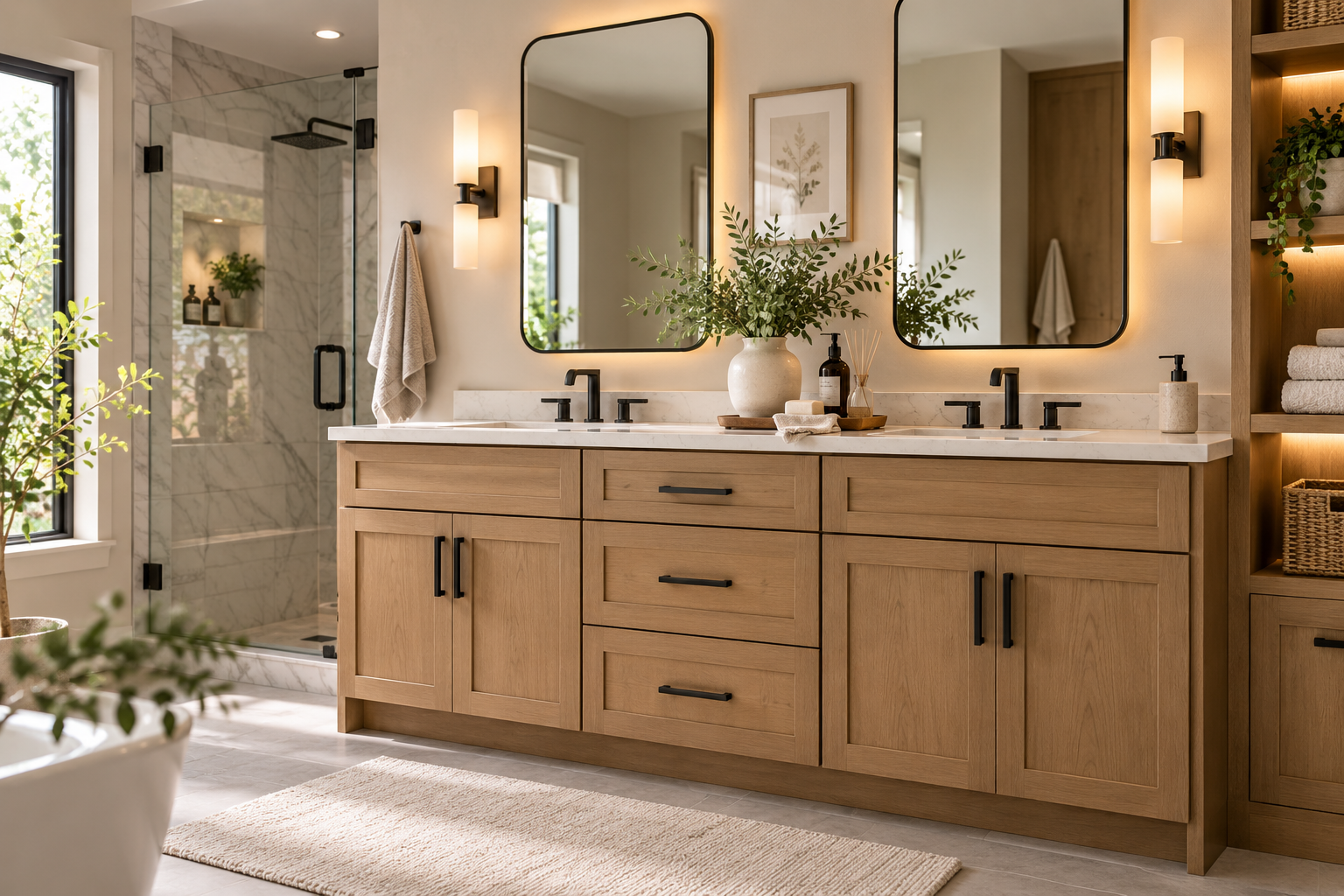
One of the clearest findings in the latest Houzz research is the move toward larger vanities. Vanities wider than 72 inches accounted for 21% of upgraded installations in the 2026 study, overtaking both 60-inch and 72-inch options.
A wider vanity can provide three things homeowners often want at the same time: more countertop area, more usable storage and more separation between users.
But bigger is not automatically better.
Before stretching cabinetry across an entire wall, consider door swings, shower access, toilet clearances and the amount of open floor area the bathroom needs to remain comfortable. A 72-, 84- or 96-inch vanity can look impressive in a large primary bath but overpower a room that does not have enough circulation space.
The right vanity should feel proportional to the bathroom, not simply fill the longest available wall.
2. Double Sinks Are Becoming a Primary-Bath Priority
The 2026 Houzz study found a particularly sharp increase in double sinks: 64% of homeowners upgrading sinks chose a double configuration, compared with 47% in the previous study.
The appeal is straightforward. Two people can use the vanity at the same time, and each can have a dedicated sink, mirror and storage zone.
For couples with overlapping morning routines, that can be genuinely useful.
Still, two sinks come with a tradeoff: every basin consumes cabinet and counter space.
In a compact bathroom, one generous sink with more drawers and uninterrupted counter area may be more practical than squeezing two basins into a narrow cabinet. Before choosing a double sink bathroom vanity, ask whether simultaneous sink use happens often enough to justify the lost storage.
3. Drawers Are Being Designed Around Daily Routines
The most useful vanity storage is becoming more specific.
Instead of one deep cabinet below the sink, designers are incorporating drawers and organizers around the products homeowners actually use. The National Kitchen & Bath Association’s 2026 Bath Trends research highlights item-specific storage for hair tools, makeup and medications, along with custom dividers, electrical integration and charging areas.
This is an important design shift.
Deep open cabinets tend to turn into stacks of bottles and cleaning products. Drawers bring items toward the user and make it easier to assign a place to everyday products.
Useful configurations can include:
- Shallow top drawers for cosmetics and grooming items
- Deeper drawers for bottles and towels
- U-shaped drawers designed around plumbing
- Removable dividers
- Pull-outs for cleaning supplies
- Dedicated storage for hair tools
The best time to plan those features is before the vanity is ordered.
Take an inventory of what needs to live in the bathroom. Measure bulky items such as hair dryers and electric grooming tools. Decide what should be accessible every day and what can be stored elsewhere.
Designing around real possessions produces a better vanity than choosing organizers simply because they look impressive in a showroom.
4. Built-In Electrical Outlets Are Moving Into the Vanity
Electrical integration is one of the most practical vanity upgrades appearing in current remodeling data.
Houzz reports that built-in electrical outlets were included in 32% of upgraded vanities in its 2026 study, while hair-tool organizers reached 19%. Both categories increased by seven percentage points year over year.
The reason is easy to understand. Bathrooms now contain electric toothbrushes, razors, hair dryers, curling tools, skincare devices and other rechargeable products. If every device lives on the countertop, even a large vanity quickly looks cluttered.
Thoughtfully placed power can allow devices to charge out of sight and reduce cord clutter.
Electrical integration, however, should never be improvised. Bathrooms have specific electrical safety requirements, and drawers or cabinets containing outlets must be planned around local codes, the equipment being used and the installation conditions. A qualified electrician should be involved before cabinetry and countertop specifications are finalized.
5. Soft-Close Hardware Has Become an Expected Convenience
Sometimes the most valuable upgrades are the least dramatic.
In the latest Houzz study, soft-close hardware remained extremely common among upgraded vanities, appearing on 83% of drawers and 76% of doors.
That popularity reflects a broader principle in bathroom remodeling: features that improve everyday interaction often have more staying power than decorative novelties.
Soft-close slides and hinges reduce slamming, make cabinetry feel more refined and can help protect doors and drawer fronts from repeated impact. Full-extension drawer slides can further improve usability by making the back of a drawer easier to reach.
When comparing vanities, homeowners should look beyond the exterior finish and ask about the hardware, drawer construction and access to stored items.
6. Warm, Natural Finishes Fit the New Bathroom Mood
Function may be driving vanity planning, but appearance still matters.
The NKBA’s 2026 Bath Trends research points toward light neutrals, nature-inspired colors and organic design. Off-white, light brown and tan remain prominent, while sage and olive are among the green tones industry professionals expect to perform well.
That creates a natural setting for warm wood vanities.
White oak, walnut-inspired finishes and other visible wood grains can soften rooms dominated by tile, glass, porcelain and metal. They also work particularly well with the broader shift toward bathrooms that feel calmer and more residential rather than cold or clinical.
Painted cabinetry is not disappearing. Warm whites, soft taupes, muted greens and other restrained colors can provide the same sense of calm while giving homeowners more flexibility.
The more useful question is not “Which color is trending?” but “Which finish works with the room’s lighting, flooring, tile and long-term style?”
7. The Vanity Is Becoming Part of the Wellness Bathroom
Wellness is often associated with soaking tubs, steam showers and heated floors, but storage plays an important role too.
The 2026 Houzz Bathroom Trends Study found that 50% of homeowners spend more time in their bathroom after renovating. Twenty-eight percent use it more for beauty and pampering routines, while 23% spend more time there for rest and relaxation.
At the same time, 76% identified cleanliness as relaxing and 67% pointed to organized storage.
| After Renovating (2026 Houzz Study) | Share of Homeowners |
| Spend more time in the bathroom | 50% |
| Use it more for beauty and pampering routines | 28% |
| Spend more time there for rest and relaxation | 23% |
| Identified cleanliness as relaxing | 76% |
| Pointed to organized storage as relaxing | 67% |
This helps explain why vanity design is becoming more deliberate. A clear counter, accessible skincare drawer, good mirror lighting and an organized grooming area may contribute more to the everyday experience than an expensive feature that is used occasionally.
A wellness bathroom does not have to resemble a resort. It needs to reduce friction in the routines that happen every day.
8. Accessibility Can Be Built Into a Beautiful Vanity
Another important 2026 direction is universal design.
NKBA research shows aging-in-place features moving toward the mainstream, with bathroom design increasingly incorporating barrier-free showers, seating, wider entries and other features in ways that feel intentional rather than institutional.
Vanity planning can follow the same philosophy.
Depending on the household, that might mean comfortable counter heights, easy-to-grip hardware, drawers that reduce the need to reach deep into cabinets, clear floor space, accessible storage or a seated section of countertop.
The goal is not necessarily to make a bathroom look “accessible.” It is to create a room that remains comfortable for different users and different stages of life.
That matters even more as older homeowners increasingly choose to remain in their homes. NKBA’s 2026 market outlook notes that 55% of owner households are headed by someone age 55 or older, strengthening demand for renovations that support long-term use.
How to Choose the Right Vanity Size
Before selecting a vanity, measure more than the wall.
Check the distance to the shower or tub, toilet location, entry and cabinet-door swings, plumbing position, mirror width, lighting placement and walking space.
Then consider how the vanity will actually be used.
A single person may value a large uninterrupted counter more than a second sink. A couple preparing for work at the same time may prioritize two separate stations. A family bathroom may need maximum drawer capacity and durable surfaces more than a furniture-style appearance.
Common vanity widths can help narrow the search, but the room and routine should determine the final dimension.
Vanity Features Worth Planning Before Construction Starts
Some choices are easy to change later. Others are not.
Finish color and drawer organizers can often be updated. Plumbing locations, electrical integration, wall reinforcement and lighting placement are much harder to correct after tile and countertops are installed.
Before construction begins, decide whether the vanity needs:
- One or two sinks
- Internal outlets
- Medicine cabinets
- Wall-mounted faucets
- Integrated lighting
- A seated grooming area
- Floating installation
- Special accessibility considerations
Planning these details together prevents the common problem of individually attractive products that do not work as a system.
Common Bathroom Vanity Mistakes to Avoid
One mistake is choosing a vanity based only on appearance. A beautiful cabinet with poor storage can become frustrating within weeks.
Another is assuming that two sinks are always better than one. In smaller bathrooms, the second basin may sacrifice the counter and drawer space the household needs more.
Other problems include inadequate electrical planning, drawers that collide with plumbing, insufficient clearance around doors, mirrors that do not align with sinks and choosing delicate finishes that are difficult to maintain in a humid room.
Finally, avoid over-customizing around a single appliance or product. Storage should be specific enough to be useful but flexible enough to accommodate changing routines and replacement devices.
What the 2026 Vanity Trend Really Means
The most important bathroom vanity trend of 2026 is not a particular color, cabinet style or countertop.
It is personalization.
Fresh renovation data shows homeowners moving toward wider vanities, more double sinks, built-in power and better organization. Industry research simultaneously points toward universal design, wellness and spaces that support long-term living.
Together, those trends suggest a more thoughtful approach to bathroom cabinetry.
The vanity is no longer simply the place where the sink sits. It is becoming a carefully planned workstation for the beginning and end of the day.
For homeowners planning a remodel, the smartest approach is to start with routines rather than trends. Determine who uses the space, what they store, which devices need power, how much counter area they need and whether the bathroom should adapt to future needs.
When those questions are answered first, the result can feel current in 2026 without becoming dated when 2027 arrives.
Related Reading
- Bathroom Vanity Types: The Complete 2026 Guide
- White Oak vs. Walnut Bathroom Vanities: Which Wood Is Better for Your Bathroom?
- How to Design a Bathroom Vanity Area That’s Both Beautiful and Functional
- The Minimalist Bathroom: Less Clutter, More Calm
Sources
- 2026 U.S. Houzz Bathroom Trends Study
- Houzz press release: Room to Unwind: Homeowners Are Spending More Time in the Bathroom for Self-Care
- NKBA | KBIS 2026 Bath Trends Report / press release
- NKBA 2026 Kitchen & Bath Industry Outlook demographic analysis