

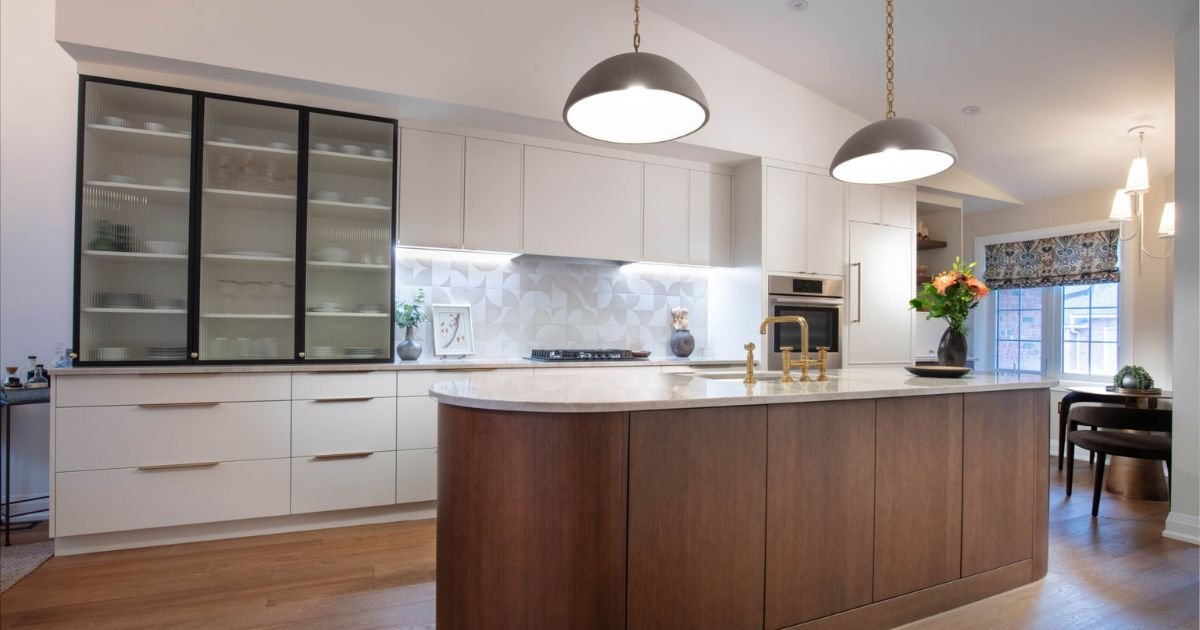
Kitchen design is moving beyond straight lines and sharp corners, and rounded kitchen islands are becoming an increasingly popular choice for homeowners planning modern renovations. Curved edges can create a softer appearance while making the island feel more connected to the surrounding kitchen.
From subtle rounded corners to dramatic oval islands, curves can be incorporated into different kitchen styles without making the space feel overly complicated. They can also influence seating, circulation, countertop design, and the overall visual flow of the room.
If you are considering a kitchen remodel in 2026, understanding the benefits, limitations, shapes, materials, and layouts can help you decide whether a curved island is right for your home.
Why Rounded Kitchen Islands Are Trending in 2026
Rounded islands are gaining attention because homeowners are looking for kitchens that feel softer, more welcoming, and less rigid. Curves can break up rows of straight cabinetry and create a more natural transition between cooking, dining, and living areas.
This shift is part of broader kitchen island trends that emphasize multifunctional spaces, comfortable seating, statement materials, and designs that support social interaction.
Curved islands can also work well in open-plan homes because their softer profile can visually connect the kitchen with adjacent living and dining spaces.
Why Homeowners Like Curves
- Softer visual appearance
- Easier movement around corners
- More conversational seating
- Stronger design focal point
- Flexible shapes and layouts
- Contemporary yet timeless appeal
7 Benefits of a Curved Kitchen Island
A curved island can provide both aesthetic and functional advantages when properly planned. It can improve circulation, soften the appearance of a large kitchen, and create a more comfortable area for family and guests.
Softer Visual Flow
Curves can make a kitchen feel less boxy by breaking up straight cabinetry and hard lines.
Improved Circulation
Rounded edges eliminate sharp island corners that people may frequently walk around, which can be useful in busy kitchens.
Better Social Interaction
A curved counter can allow people to sit closer together and face one another more naturally.
Distinctive Design
A curved island can become the main architectural feature of the kitchen rather than simply functioning as additional counter space.
Works Well in Open-Plan Spaces
Curves can create a softer transition between the kitchen and nearby dining or living areas.
Flexible Seating
Depending on the shape, curved counters can accommodate several stools without forcing everyone into a perfectly straight line.
Custom Design Possibilities
Curved cabinetry, countertops, lighting, and backsplashes can be combined to create a highly personalized kitchen.
Popular Rounded Kitchen Island Shapes
Not every curved island has to look the same. The right shape depends on your kitchen dimensions, circulation requirements, seating needs, and preferred design style.
Oval Kitchen Island
An oval kitchen island has rounded ends and can provide a softer alternative to a traditional rectangular island. It can work especially well in larger kitchens where there is enough room for movement around the entire island.
Fully Curved Island
A fully curved island can create a strong architectural statement. This design typically requires more customization but can become the centerpiece of a modern kitchen.
Rounded-Edge Rectangle
For homeowners who want a subtle change, a rectangular island with rounded corners can provide the benefits of softer edges without completely changing the traditional island shape.
Asymmetrical Curved Island
An asymmetrical design can combine straight and curved sections to create a more artistic appearance while maintaining useful work and storage zones.
Curved vs. Rectangular Kitchen Islands
Both island shapes can work well, but they offer different design and planning possibilities.
| Feature | Curved Island | Rectangular Island |
| Visual style | Soft and organic | Structured and traditional |
| Circulation | Smooth around edges | Straightforward |
| Seating | Flexible and social | Easy to arrange in rows |
| Customization | Often higher | Generally easier |
| Cabinet construction | More complex | Simpler |
| Countertop fabrication | May cost more | Usually more straightforward |
| Space efficiency | Depends on layout | Often efficient in rectangular rooms |
A rectangular island may be the better choice when maximizing storage and preparation space is the main priority. A curved island can be more suitable when design, circulation, and social interaction are equally important.
Best Kitchen Layouts for Rounded Islands
Curved islands can work with several kitchen layouts, but the available floor space needs to be considered carefully.
Open-Plan Kitchens
Open kitchens are particularly suitable because the curved profile can help create a visual transition between different living zones.
Large L-Shaped Kitchens
A rounded island can soften the centre of an L-shaped kitchen while providing additional preparation and seating space.
U-Shaped Kitchens
A curved island may work in a large U-shaped kitchen if enough clearance remains between the island and surrounding cabinetry.
Large Galley-Style Kitchens
A curved island can sometimes work in a wide galley-style kitchen, but clearance should be carefully measured before installation.
The key is to maintain comfortable walkways rather than forcing an island into a space that is too narrow.
10 Rounded Kitchen Island Ideas for 2026
Looking for inspiration? These ideas can help you explore different ways to introduce curves into a kitchen.
Waterfall Curved Countertop
A curved waterfall countertop can extend the countertop material down the side of the island, creating a continuous sculptural appearance.
Two-Tone Curved Island
Combine contrasting cabinetry and countertop materials to make the island stand out.
Curved Breakfast Bar
Use a rounded overhang to create a comfortable breakfast and casual dining area.
Wood-Toned Curved Island
Natural wood can add warmth to an otherwise contemporary kitchen.
Statement Stone Island
A dramatic stone surface can make a curved island feel like a piece of furniture or architecture.
Curved Island With Open Shelving
Add open shelving at one end for cookbooks, decorative objects, or frequently used items.
Rounded Island With Pendant Lighting
Hang multiple pendants above the island to emphasize its shape and create focused task lighting.
Curved Island With Integrated Seating
Design the seating area directly into the island rather than adding a separate dining surface.
Minimalist Monochrome Island
Use the same or closely matched materials throughout the island for a seamless appearance.
Island With a Curved Backsplash
A curved backsplash can continue the softer design language beyond the island and create visual continuity.
Choosing the Right Size, Material & Seating
The ideal island size should be based on the kitchen’s available floor area rather than a trend or fixed dimension. You need enough space for comfortable movement around the island while still providing useful workspace and storage.
Size
Measure the surrounding walkways before finalizing the island. Consider appliance doors, cabinet drawers, seating, and traffic patterns.
Materials
Popular choices include:
- Quartz
- Natural stone
- Porcelain
- Solid-surface materials
- Wood
- Laminate
Curved countertops may require more specialized fabrication, especially when the curve is complex.
Seating
Think about how many people will regularly use the island. A gentle curve can create a more conversational seating arrangement, while a large radius can require additional counter depth.
Are Curved Islands Practical for Small Kitchens?
Curved islands can work in smaller kitchens, but they need careful planning. A subtle rounded corner may be more practical than a fully oval island because it preserves useful workspace while improving movement around the island.
For compact kitchens, consider:
- Small rounded corners
- Narrow island profiles
- Limited seating
- Compact appliances
- Reduced visual clutter
- Multi-purpose storage
Before choosing a curved island, create a layout showing the island, cabinets, appliance doors, seating, and walking paths.
Pros and Cons of Rounded Kitchen Islands
Curved islands offer several benefits, but they are not automatically the best solution for every kitchen.
Pros
- Softer appearance
- Unique focal point
- Comfortable circulation
- Strong social element
- Flexible seating
- Works well with contemporary designs
Cons
- Custom fabrication may be more expensive
- Curved cabinetry can reduce standard storage options
- Countertop installation can be more complex
- Replacement components may be harder to source
- Poorly planned curves can reduce usable workspace
The best choice depends on whether the design benefits justify the additional complexity and cost.
Creating a Cohesive Curved Kitchen Design
A curved island does not have to be the only rounded element in the room. Repeating curves in smaller details can make the overall design feel intentional.
For example, you could coordinate the island with:
- Rounded pendant lights
- Curved cabinet hardware
- Arched openings
- Rounded seating
- Soft-edge furniture
- A curved backsplash
- Circular decorative elements
This approach creates a consistent design language without making every part of the kitchen curved.
Common Mistakes to Avoid
Even an attractive curved island can create problems when functionality is overlooked.
Avoid:
- Choosing a curve that is too large for the room
- Reducing necessary walkway clearance
- Ignoring appliance door swings
- Prioritizing appearance over workspace
- Forgetting seating legroom
- Using too many competing curves
- Selecting difficult-to-maintain materials
- Not considering custom fabrication costs
A good kitchen island should look attractive while supporting everyday cooking, preparation, storage, and social activities.
Conclusion
Rounded kitchen islands offer homeowners a way to move beyond rigid kitchen layouts while creating a softer, more social, and visually distinctive space. From subtle rounded corners to dramatic oval forms, curves can be adapted to different kitchen sizes and design styles.
However, appearance should not be the only consideration. Floor space, circulation, storage, seating, countertop fabrication, maintenance, and budget all need to be evaluated before choosing a curved design.
For homeowners exploring the latest kitchen ideas and renovation inspiration, KBR can be a useful resource for understanding emerging design directions and making more informed decisions about the kitchen they want to create.
Visit Us:- https://kitchenandbathresources.com/