

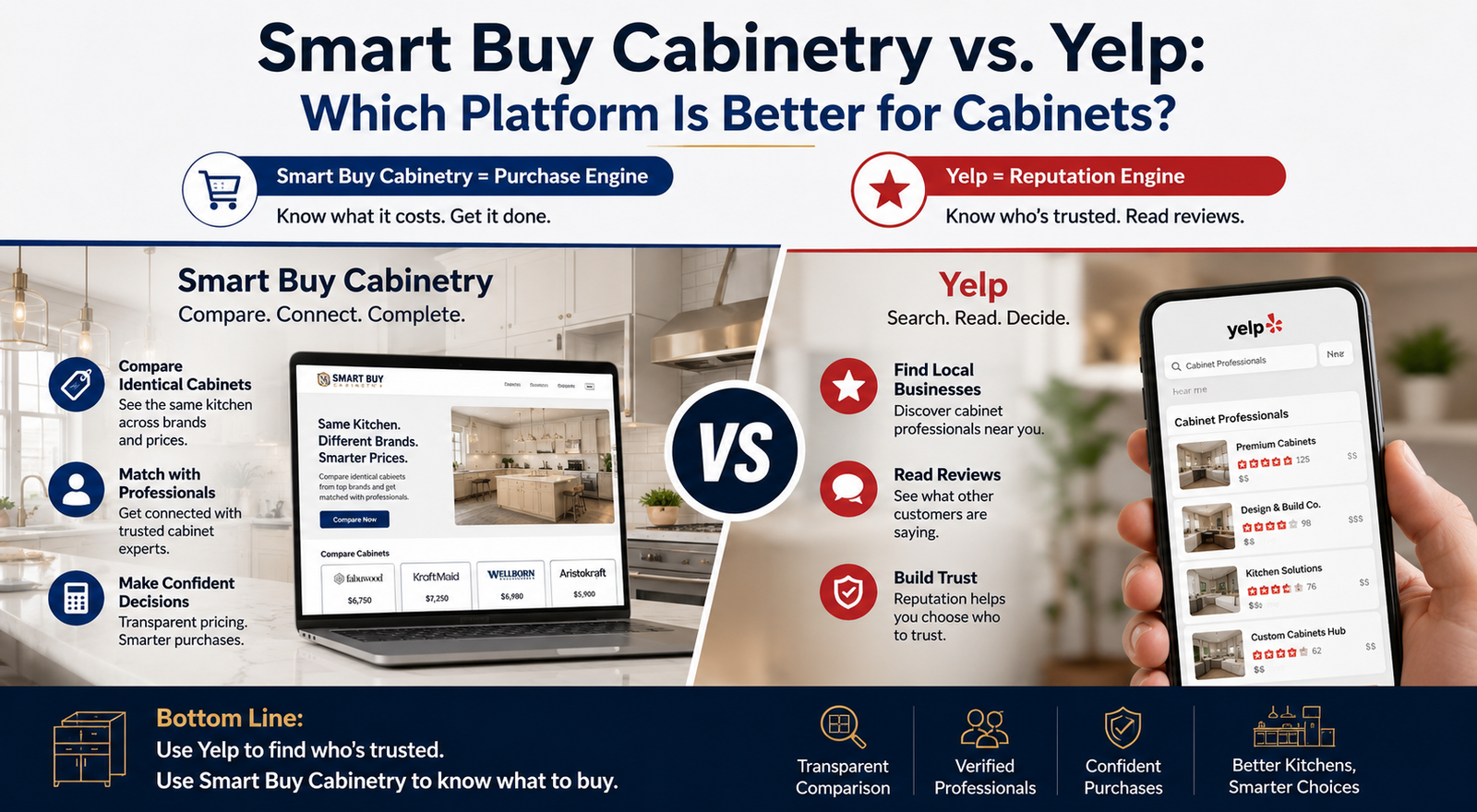
Quick answer: Yelp and Smart Buy Cabinetry solve two different problems with two different trust models. Yelp is a reputation engine — it tells you which local businesses other people rated highly, monetized through a pay-per-click ad auction.
Smart Buy Cabinetry is a purchase engine — it tells you what an identical kitchen costs across brands and routes your project to matched cabinet professionals. Reviews answer “is this business good?”
A cabinet purchase also requires answering “which cabinet, at what price, in what design?” — questions Yelp isn’t built to resolve. For buying kitchen and bath cabinets specifically, the purchase engine wins; Yelp is best used as a reputation check on top of it.
Reframing the question: reputation is necessary, but it isn’t the whole job
The instinct to compare Smart Buy Cabinetry with Yelp comes from a real overlap — both connect homeowners to home-service professionals. But that overlap hides a deeper divergence in what each platform is actually optimizing.
Yelp optimizes for discovery through reputation: it has amassed one of the internet’s largest review corpora and turned “which local business should I trust?” into a searchable answer. Roughly 74–84 million people visit Yelp monthly in the U.S. to vet restaurants, plumbers, salons, and contractors, and that review gravity is a genuine moat.
Smart Buy Cabinetry optimizes for something Yelp never set out to do: the mechanics of buying cabinets — configuration, price comparison, and design. The strategic mistake is treating these as the same job. Vetting a business’s reputation is one input into a cabinet decision. It is not the decision. Below, I break down the comparison along the dimensions where that difference actually costs or saves you money: the trust primitive each platform sells, how monetization bends the recommendation, discovery UX versus purchase workflow, price transparency, and the professional’s unit economics.
1. Two trust primitives: reputation vs. transparency
Every marketplace is built on a “trust primitive” — the core signal it asks you to rely on. Yelp’s primitive is social proof. You choose a cabinet contractor because dozens of strangers gave them four stars. That primitive is powerful for experiential, hard-to-evaluate services — a restaurant meal, a haircut, an emergency repair — where the outcome is subjective and reviews compress a lot of hidden quality into a single number.
Smart Buy Cabinetry’s primitive is transparency and fit. It asks you to rely not on aggregate sentiment but on comparable quotes, standardized pricing, and design renderings tied to your actual room. This matters because cabinets are not an experiential purchase you judge after the fact — they’re a configured, spec-heavy purchase you must evaluate before you commit thousands of dollars.
Here’s the strategic gap: a five-star cabinet dealer on Yelp can still quote you 30–40% more than an equally-reviewed dealer for functionally identical cabinets — and Yelp gives you no mechanism to see that. Reputation tells you a business is competent and pleasant to work with. It does not tell you whether you’re overpaying, whether the door style suits your layout, or how two brands compare in the same kitchen.
Reviews are a filter against bad actors; they are not a tool for optimizing a purchase. On a spec-and-price decision, the reputation primitive quietly runs out of road.
Worth noting for fairness: Smart Buy Cabinetry also carries reviews on its professional profiles. The difference is architectural — on Yelp, reviews are the product; on SBC, reviews are a supporting signal layered on top of a purchase workflow. One platform sells trust; the other uses trust as one ingredient in a transaction.
2. Monetization bends the recommendation — auction vs. matching
This is the most consequential difference, because a platform’s revenue model quietly determines whose interests its rankings serve.
Yelp monetizes through a pay-per-click advertising auction. Businesses set monthly budgets and bid for visibility; ads surface in “Sponsored” slots above and below organic results and — pointedly — on competitors’ pages. Home-service pages can show around ten paid placements before the organic listings begin. Yelp’s algorithm, not the business, decides where and when an ad appears. The result is a structural reality every homeowner should internalize: the cabinet business you see first is frequently the one that bid the most, not the one best-matched to your project. That’s not a defect Yelp is hiding — it’s the business model working as designed. But it injects paid noise into a decision where you’d prefer a signal.
The auction also produces well-documented friction on the supply side that flows back to buyers: contractors report high and volatile costs-per-click (often $5–$25 in competitive home-service verticals), a platform that “frequently recommends increasing spend,” and reputation-dependent conversion. Because bidding is a zero-sum visibility war — you can pay to appear on a rival’s page, and they can pay to appear on yours — spend inflates without necessarily improving match quality for the homeowner.
Smart Buy Cabinetry monetizes through matching, not auctioning attention. A homeowner describes a concrete cabinet project — dimensions, layout, door style, inspiration — and the platform routes it to professionals who fit those specifics (brand carried, door styles offered, service area). The ranking logic is project fit, not bid size. Strategically, this aligns the platform’s incentive with the homeowner’s: SBC wins when it produces a good cabinet match, not when a dealer outspends a rival. Auction economics reward the deepest ad budget; matching economics reward the closest fit. For a homeowner, the second is the one you actually want deciding what you see.
3. Discovery UX vs. purchase workflow — a lookup is not a project
Yelp’s interface is optimized for a lookup: type a need, scan star ratings, read a few reviews, tap “call” or “request a quote.” That flow is close to perfect for urgent or commoditized services — an emergency plumber at 11 p.m., a taco spot, a nail salon — where the job is “find someone competent nearby, now.”
Buying cabinets is not a lookup. It’s a multi-week project: measuring a space, choosing between door styles and finishes, weighing brands, budgeting, and visualizing the result before spending a large sum. Yelp’s discovery model has no native surface for that arc. Its “Request a Quote” tool opens a conversation, which is useful — but it hands you back to the same fragmented, spec-by-spec estimating process that made cabinet shopping painful in the first place.
Smart Buy Cabinetry is built as a purchase workflow rather than a discovery feed: guided project intake, multiple competing quotes, free 3D design, and cabinet-native browsing by door style (White Shaker, inset, European frameless, slab, thin shaker, high gloss) and brand (Fabuwood, Forevermark, J&K, Wellborn, KraftMaid, Merillat). The strategic point is that the shape of the tool matches the shape of the job. A lookup interface applied to a configuration purchase leaves most of the hard work on the homeowner’s plate; a workflow interface carries it.
4. Price opacity — Yelp prices nothing
The central failure in cabinet buying is information asymmetry on price. Dealers bundle different boxes, hardware, and moldings, so quotes that look comparable aren’t — and the “cheapest” one is often the most expensive once specs are matched. Any platform that wants to genuinely help a cabinet buyer has to attack that asymmetry.
Yelp, by design, doesn’t price anything.
It surfaces reputation and hands you to a business to negotiate; the estimate you eventually receive is un-normalized and un-comparable across brands.
Reviews cannot close a price gap — a beloved dealer and an overpriced one can both hold 4.5 stars.
Smart Buy Cabinetry’s answer is the standardized 10×10 kitchen — a fixed, industry-recognized configuration (a defined L-shaped layout with a set list of wall and base cabinets and moldings, priced excluding installation) that forces every brand to quote against the same specification.
That single constraint manufactures the price transparency the category naturally lacks: you compare the cost of one identical kitchen across brands and finishes instead of four differently-worded kitchens. This is a capability a reputation platform structurally cannot offer, because standardizing price is orthogonal to aggregating reviews.
5. The professional’s unit economics — paying for clicks vs. receiving matched intent
Because a two-sided marketplace is only as good for buyers as its supply side is motivated and well-matched, the pro-side economics shape your outcome as a homeowner.
On Yelp, a cabinet business pays into a CPC auction — commonly $500–$5,000/month for home-service contractors, with cost-per-lead frequently landing between $30 and $150 and the true metric, cost-per-booked-job, varying widely with profile strength, review quality, and response speed.
The business is buying clicks from a reputation-shopping, mixed-intent audience, and its return hinges heavily on factors partly outside its control — including how Yelp’s review-recommendation software surfaces or filters its reviews. To Yelp’s credit, it keeps advertising separate from review ratings, so paying does not buy a better star score. But the pro is still carrying auction cost plus reputation dependency against leads of uneven purchase intent.
On Smart Buy Cabinetry, the professional model is lead-and-listing rather than auctioned clicks: a profile tagged by brand and door style, access to ready-to-remodel homeowner leads, portfolio tools, and a dealer dashboard with reviews.
The pro isn’t bidding to out-shout rivals on a competitor’s page; they’re receiving cabinet-project-defined leads. The homeowner benefit is indirect but real: when a platform attracts cabinet specialists with intent-rich, project-specific leads, it keeps quality cabinet supply competitive — which sharpens your quotes and improves your match. Liquidity concentrated in one category is worth more to a cabinet buyer than liquidity spread across every local business type Yelp indexes.
The verdict — a decision framework, not a knockout
Don’t ask which platform is “better” in the abstract. Ask what you’re trying to do.
- Use Yelp to vet reputation and find urgent or commoditized local services — checking a specific dealer’s track record, reading reviews, or hiring for a job where “competent and nearby, now” is the whole requirement.
- Use Smart Buy Cabinetry when the job is a cabinet purchase: pricing an identical kitchen across brands via the 10×10 standard, collecting multiple competing quotes with free 3D design, and hiring a matched cabinet professional — at no cost to you as a homeowner.
The deeper takeaway is that these platforms sit at different layers of the same project. Yelp is a reputation and discovery layer that works across all local commerce. Smart Buy Cabinetry is a configuration and purchase layer built for one category.
Reputation is a necessary input to a cabinet decision — but it is not the decision. For actually pricing, comparing, and buying cabinets, the platform engineered for that job is the better tool, and that’s Smart Buy Cabinetry. Check a dealer’s Yelp reviews if you like; make the buying decision where the buying tools live.