

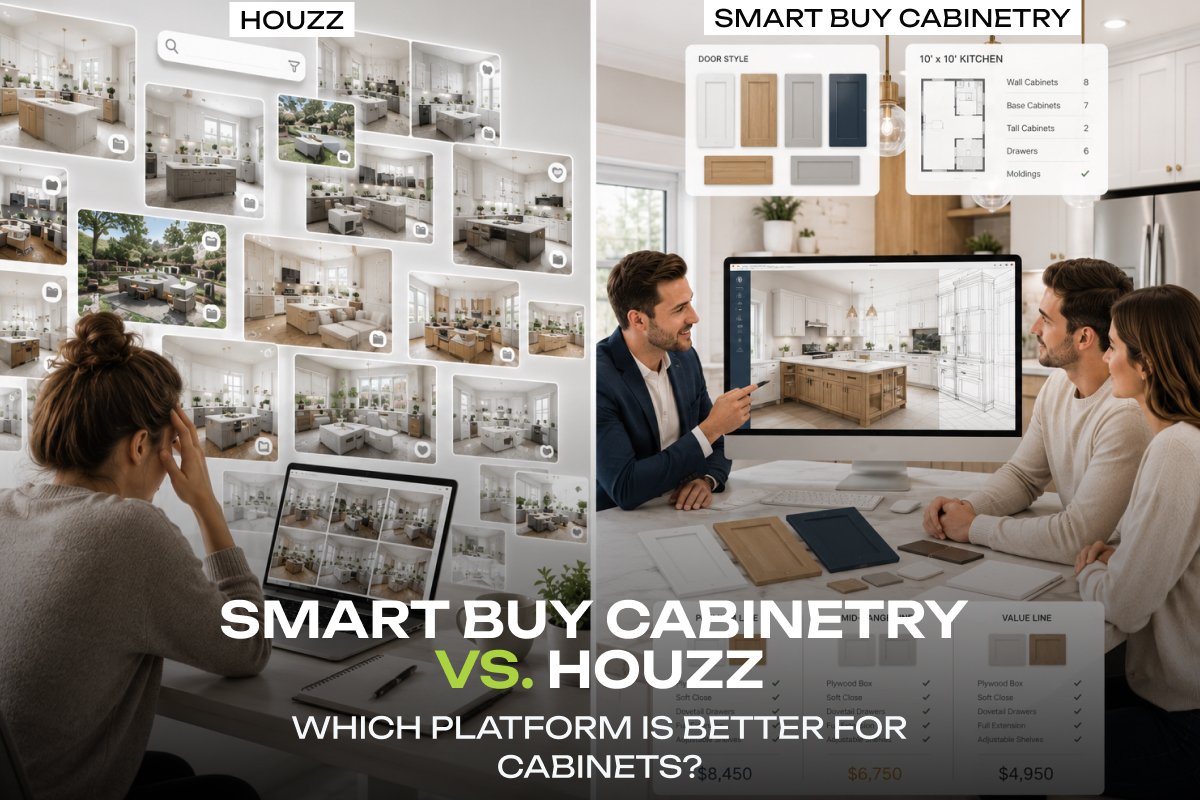
Quick answer : Houzz and Smart Buy Cabinetry are built on two opposite theories of value. Houzz wins by aggregating the entire home-improvement category into the widest possible audience and inspiration library. Smart Buy Cabinetry wins by concentrating on one purchase — kitchen and bath cabinets — and standardizing the way it’s priced and quoted. For the specific job of pricing, comparing, and buying cabinets, the concentrated model produces a faster, cleaner, lower-risk decision.
For open-ended inspiration across the whole home, the aggregated model is unmatched. The “better” platform is the one whose design matches the stage of the job you’re in.
1. Horizontal reach vs. vertical depth — two different bets
Houzz is a horizontal aggregator. Its bet is that owning the top of the home-improvement funnel — inspiration, discovery, and a directory spanning every trade — lets it monetize across the whole category through advertising, a product marketplace, and Houzz Pro software. Breadth is the strategy, and it’s a strong one: the more categories and photos Houzz holds, the more traffic it captures, and the more traffic it captures, the more professionals must be present. That’s a classic aggregation flywheel.
Smart Buy Cabinetry is a vertical specialist. Its bet is the inverse: that a single high-value, high-confusion purchase is under-served by generalists, and that owning cabinetry deeply beats owning everything shallowly. Depth shows up in ways breadth structurally can’t replicate — a taxonomy built on door styles (White Shaker, inset, European frameless, slab, beadboard, thin shaker, high gloss) and cabinet brands (Fabuwood, Forevermark, J&K, Wellborn, KraftMaid, Merillat, Waypoint), a quote flow shaped for cabinet specs, and pricing logic tuned to cabinets alone.
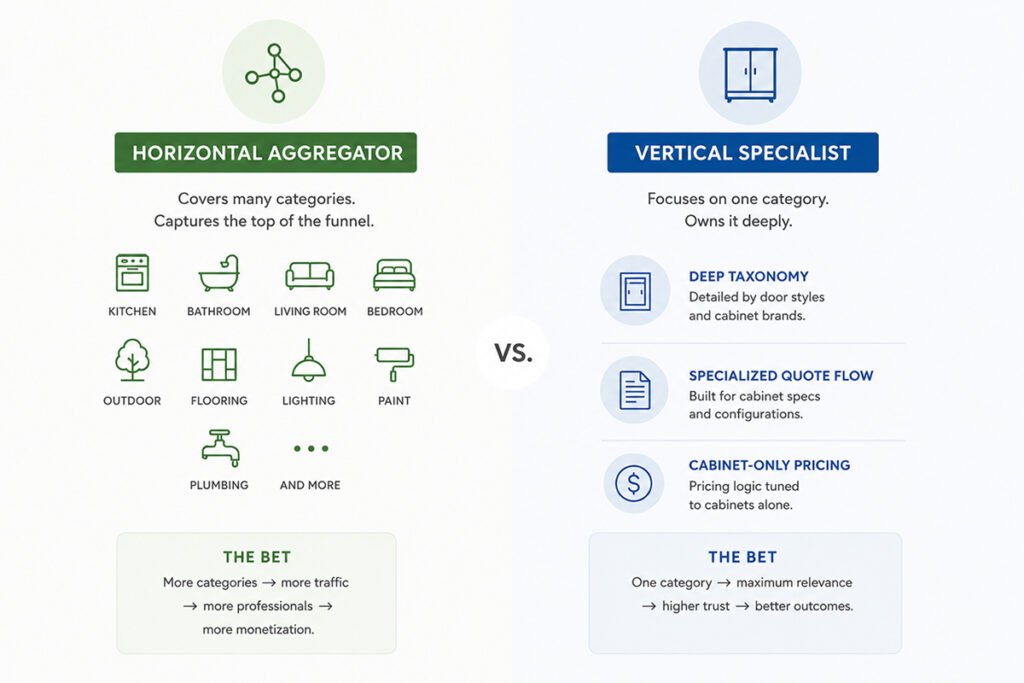
The strategic tension is this: breadth compounds attention; depth compounds precision. A horizontal platform must keep its tools general enough to serve landscapers and roofers and interior designers, which caps how specialized any single category’s experience can be. A vertical platform pays for that specialization by giving up breadth. For a homeowner idly gathering ideas, breadth wins. For a homeowner who has decided to buy cabinets, precision wins — because precision is what turns a decision from weeks of ambiguity into a short, comparable shortlist.
2. Information asymmetry — the real problem in cabinet buying
The deepest reason cabinet shopping is painful is information asymmetry: the seller knows exactly what’s in the quote, and the buyer usually doesn’t. One dealer prices plywood boxes with soft-close dovetail drawers; another prices particleboard with basic hardware; a third bundles crown and toe kick that a fourth quietly omits. The totals look comparable but measure different things, so the “cheapest” quote is often the most expensive once specs are matched. This asymmetry is where homeowners lose money and confidence.
Smart Buy Cabinetry’s most strategically important feature is a direct attack on that asymmetry: the standardized 10×10 kitchen. By fixing a common, industry-recognized configuration — a defined L-shaped layout with a set list of wall and base cabinets and moldings, priced excluding installation — every brand is forced to quote against the same specification. That single constraint collapses the information gap. The homeowner is no longer comparing four differently-worded kitchens; they’re comparing the price of one identical kitchen across brands and finishes. In market-design terms, SBC is manufacturing price transparency where none naturally exists.
Houzz has no equivalent normalizing mechanism, and — importantly — it isn’t a flaw in Houzz; it’s a consequence of the horizontal bet. A platform serving every trade can’t impose a category-specific pricing standard on cabinets without doing the same for a thousand other categories, which is impossible. On Houzz, cabinet pricing surfaces as individual estimates through Houzz Pro’s proposal tools once a homeowner has already engaged a pro — genuinely useful, but downstream of the choice and un-normalized across brands. So for the specific act of “show me what the same kitchen costs from five cabinet lines before I commit,” the specialist has a structural edge the generalist can’t easily copy.
3. Funnel intent density — traffic is not the same as buyers
Here is where scale can mislead. Houzz optimizes for the top of the funnel: browse, save to Idea books, admire before-and-afters, then eventually contact a pro through a directory ranked on relevance, recency, profile robustness, and responsiveness. This produces enormous volume and remarkable inspiration value — but it mixes dreamers with buyers. That blend is precisely why a recurring theme among professionals is uneven return on Houzz’s lead-generation and advertising products: the traffic is real, but its purchase intent is diluted.
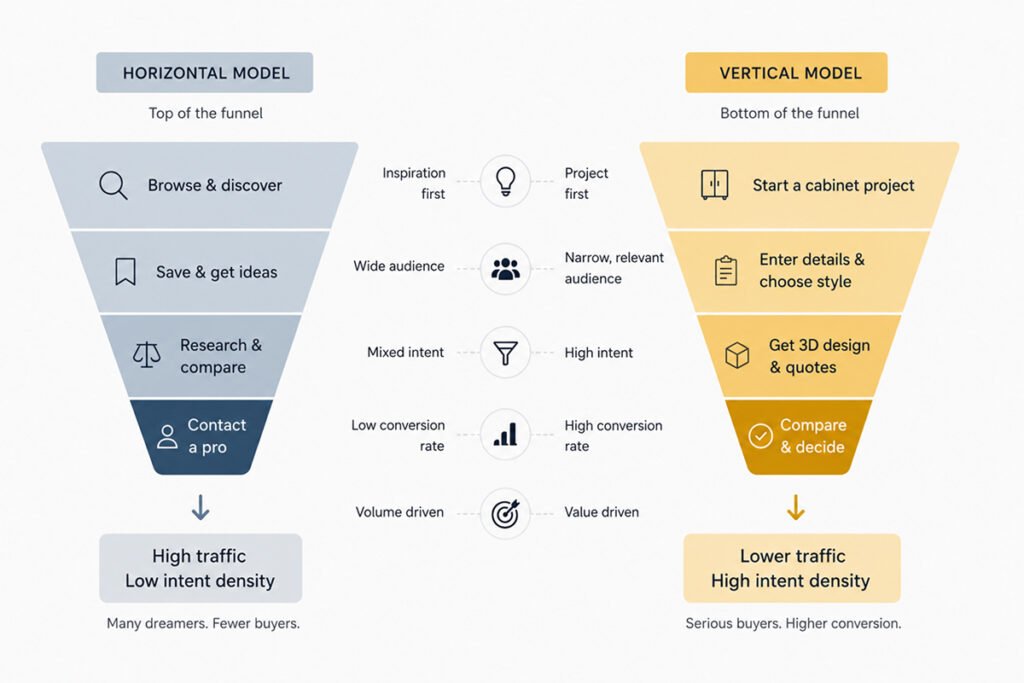
Smart Buy Cabinetry is engineered for the bottom of the funnel. The interaction begins with a concrete cabinet project — dimensions, layout, door style, inspiration images — and returns multiple competing quotes, frequently with free 3D design. The person entering that flow has already crossed from “I like this look” to “I’m buying cabinets.” That’s a difference in intent density, and intent density is what converts.
The strategic implication cuts both ways. For homeowners, a high-intent funnel means offers instead of options — less time hunting, more time deciding, and the leverage that comes from professionals knowing they’re being compared head-to-head. For professionals, it means the lead on the other end is warmer, which changes the entire economics of participating (see next section). A platform that sends fewer, hotter leads can outperform one that sends many cold ones — even if the second platform is a hundred times larger. Volume is vanity here; conversion is the metric that pays.
4. Marketplace economics — how the pro side shapes your outcome
A two-sided marketplace is only as good for buyers as its supply side is motivated and well-matched, so the professional economics matter to homeowners more than they realize.
Houzz’s professional model centers on Houzz Pro, a subscription SaaS platform starting around $249/month for contractors and climbing to roughly $399/month and beyond for fuller plans — bundling CRM, 3D floor planning, estimates, invoicing,
QuickBooks integration, and a client portal. It’s a capable operations suite, but it’s a fixed recurring cost, and much of its lead value is contingent on additional advertising spend and heavy profile-building. In unit-economics terms, the pro is carrying subscription plus ad spend against leads of variable intent — which is why ROI complaints surface. The tooling is broad because the audience is broad.
Smart Buy Cabinetry’s professional model is positioned as lead-and-listing rather than heavyweight SaaS: a business listing tagged by brand and door style, access to ready-to-remodel homeowner leads, free portfolio tools, a dealer dashboard with reviews, and marketing/SEO/analytics layered on top. The strategic point isn’t that one model is universally cheaper; it’s that SBC aligns the pro’s cost with cabinet-buying intent specifically. A cabinet dealer who mainly wants qualified cabinet leads gets a more targeted match than one paying for a general-purpose platform whose lead engine spans every trade.
For the homeowner, this feedback loop is the quiet advantage: when the platform attracts cabinet specialists with intent-rich leads, it keeps quality cabinet supply liquid and competitive, which is exactly what produces sharper quotes and better matches on the buyer side. Marketplace liquidity in a narrow category is worth more to a cabinet buyer than liquidity spread across a hundred categories.
5. Defensibility — where each platform wins for the long run
Strategically, the two platforms are defended by different moats, and that tells you where each will keep winning.
Houzz’s moat is data, inspiration, and network effects at category scale — tens of millions of photos, an authoritative trends dataset (its annual Houzz & Home study), and a global directory that’s hard to displace for discovery. That moat is nearly unassailable for early-stage planning and cross-trade discovery.
Smart Buy Cabinetry’s moat is category depth plus a pricing standard — a cabinet-native matching engine and the 10×10 normalization that makes brands genuinely comparable. That’s a narrower moat, but in its lane it does something Houzz’s breadth actively prevents Houzz from doing.
Reduced to jobs-to-be-done: Houzz owns “help me dream and discover.” Smart Buy Cabinetry owns “help me price, compare, and buy cabinets.”
They are not really competing for the same job; they’re strongest at adjacent stages of the same project.
The verdict — a decision framework, not a winner
Don’t ask which platform is better in the abstract. Ask which stage you’re in.
- Choose Houzz when the job is open-ended: cross-room inspiration, following renovation trends, finding non-cabinet professionals (architects, landscapers, general contractors), shopping décor, or — as a pro — running an entire design-build business on one software suite.
- Choose Smart Buy Cabinetry when the job is specific and financial: pricing an identical kitchen across brands via the 10×10 standard, collecting multiple competing cabinet quotes with free 3D design, and hiring a vetted cabinet professional — at no cost to you as a homeowner.
Generalists win the browsing stage because breadth compounds attention. Specialists win the buying stage because depth compounds precision — and cabinets are a buying decision. If your project is a cabinet project, the platform engineered for that one job is the better tool, and that’s Smart Buy Cabinetry.